
Taking Shape
Hydrogen power for the next era of mobile cranes
As the heavy lifting industry strives to decarbonize, among other approaches, mobile crane manufacturers are accelerating development of hydrogen-powered alternatives to traditional diesel engines. From hydrogen combustion engines to fuel cell architectures, multiple technologies are being evaluated to ensure they can provide the durability and performance required for demanding lifting operations.
The crane industry has historically relied on diesel engines for their power density, reliability and global fuel availability. However, to reduce greenhouse gas emissions, hydrogen is increasingly viewed as a long-term solution. While technology approaches come with advantages and trade-offs, the industry is converging on two main hydrogen pathways:
- Hydrogen internal combustion engines (ICE)
- Hydrogen fuel cell electric systems
At Liebherr, the company is testing a 9-liter hydrogen internal combustion engine, designed to integrate into its established LTM all-terrain chassis platform. By leveraging familiar engine architecture, hydrogen ICE technology also allows Liebherr to leverage engineering expertise and manufacturing capacity, reducing development complexity.
This approach also reflects an understanding of crane operations. Mobile cranes operate under intense and highly variable load conditions, an environment where combustion-based systems may provide greater resilience than fuel cells.
Zoomlion, with its ZAT2200VE863 220-ton hybrid all-terrain crane is focused on hydrogen fuel cell systems. The company is also exploring other solutions rather than committing to a single technology, reflecting uncertainty about how hydrogen infrastructure will evolve.
Specialized manufacturers like JMG Cranes are pushing the frontier of hydrogen fuel cell implementation in compact mobile equipment. The company’s MC250.09FL fuel cell crane represents one of the attempts to integrate fuel cell propulsion into lifting machines.
Although still in early stages, these developments demonstrate that hydrogen power is not limited to large-scale cranes—it can also be applied to smaller, highly mobile equipment.
While larger mobile cranes are still in early-stage hydrogen development, port and industrial cranes are moving faster, particularly in the adoption of fuel cell technology for equipment that operates at fixed locations and can access a dedicated fueling infrastructure.
Activity in these markets at Konecranes highlights two parallel development paths. One is the use of hydrogen combustion engines, often paired with hybrid systems, while another is fuel cells, which offer higher efficiency and zero-emissions operation.
Core Challenges
In all areas of hydrogen power system development, cost remains a major consideration. Hydrogen combustion engines are compatible with existing platforms at a lower initial cost and are generally more robust under variable loads. Hydrogen fuel cells potentially offer higher efficiency but at a higher upfront cost.
Fueling also remains a fundamental issue. Unlike electric cranes, which can rely on grid access, hydrogen-powered mobile cranes require:
- Portable or widely available refueling stations
- Reliable hydrogen supply chains
- Standardized fueling protocols
For cranes that frequently move between jobsites, the lack of infrastructure is a critical barrier to adoption. Until hydrogen refueling becomes more accessible, large-scale deployment of hydrogen-powered mobile cranes will likely remain limited.
While the industry’s dual-track approach reflects unresolved questions about which technology will dominate, both technologies are expected to coexist with combustion engines potentially leading in mobile applications while fuel cells gain ground in fixed or semi-fixed operations.
The Road Ahead
Hydrogen development in the crane industry is still in a formative stage, but several trends are clear:
- Major OEMs are actively investing in hydrogen powertrain research and development
- Hybrid and flexible designs are becoming more common
- Engine suppliers are accelerating commercialization
- Infrastructure remains the key bottleneck
The transition will likely occur gradually, with hydrogen engines first appearing in pilot fleets and specialized applications before scaling more broadly.
Overall, hydrogen is no longer a distant concept for the crane industry. It is a rapidly advancing reality as manufacturers lay the groundwork for a new era of zero-emissions lifting. While challenges remain, the direction is clear: hydrogen will play a central role in the future of mobile cranes.
--
Scalable and Proven
Engine manufacturer Cummins is playing a central role in hydrogen adoption across off-highway sectors. The company’s heavy-duty X15H engine, intended to serve as a drop-in replacement for traditional diesel systems, is particularly significant for crane OEMs as it provides a proven platform without requiring a complete redesign of machine architecture.
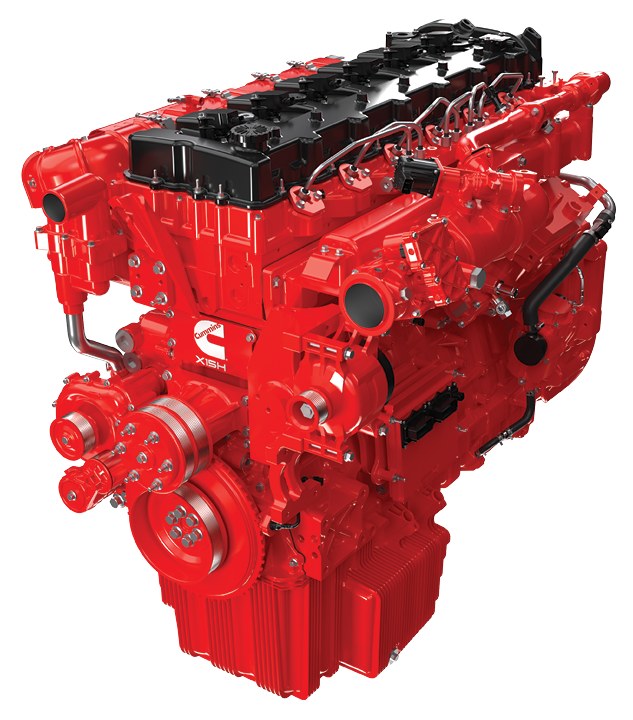
Hydrogen engines share many similarities with conventional diesel engines, making them a familiar solution for heavy equipment manufacturers. Key characteristics include:
- The use of many of the same components as diesel engines, allowing manufacturers to leverage existing platforms and expertise.
- Hydrogen-powered machines can be refueled quickly — similar to diesel — reducing downtime.
- Hydrogen engines build on proven diesel designs, offering a
pathway to scale production efficiently.
Adoption of hydrogen engines and power systems will ultimately be driven by their reduced carbon footprint, helping companies in the crane industry reduce greenhouse gas output, supporting broader sustainability goals.