Modernizing Industrial Lifting
Carry deck cranes continue to prove their value where space constraints, productivity demands, and operational flexibility are critical
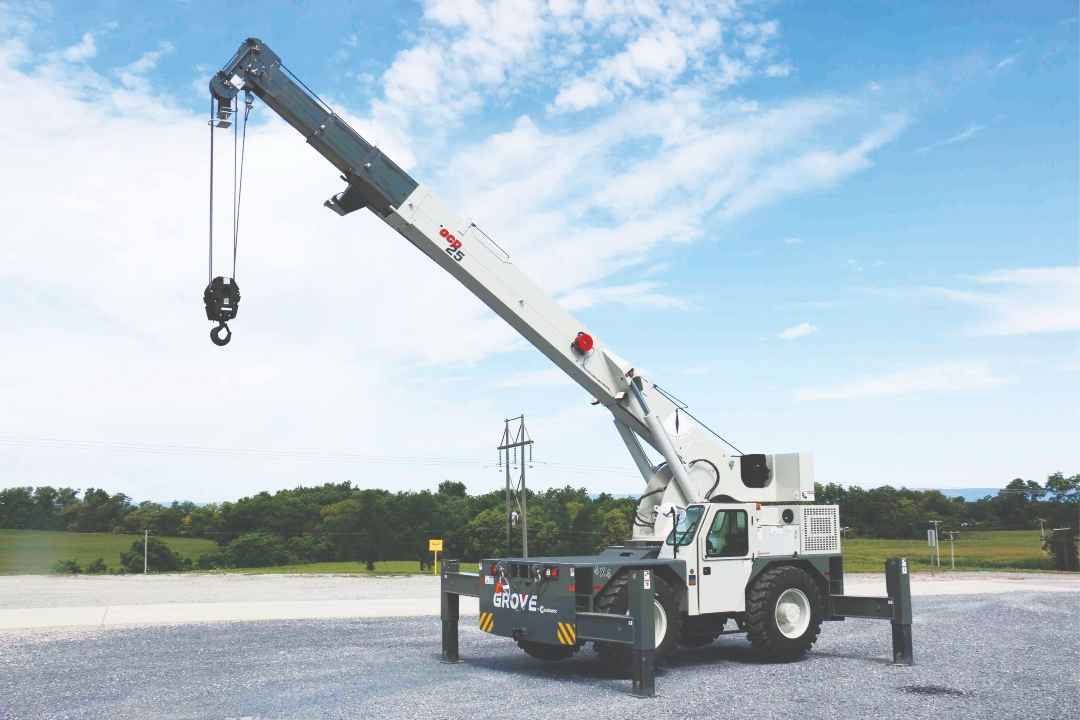
Manitowoc’s Shuttlelift and Grove carry deck models have capacities that range from 9 to 25 tons. The GCD25/SCD25 features a 71-foot boom and an optional 17-foot offsettable swingaway extension and can deliver a maximum tip height of 95 feet.
Designed to lift, transport, and position loads with a single machine, carry deck cranes occupy a unique place in the industrial lifting equipment market. Their ability to work in confined spaces while maintaining impressive lifting capacities has made them indispensable for utilities and construction operations, and across manufacturing plants, refineries, warehouses, and shipyards.
As infrastructure investment, industrial expansion, and facility maintenance projects continue to generate demand for versatile lifting equipment, carry deck models enhance performance, safety, and efficiency. These wheel-mounted cranes designed for mobile material handling in areas where larger cranes cannot easily operate do not require extensive setup to pick up a load, transport it, and place it precisely at its destination.
According to Herc Rentals, key carry deck crane characteristics include compact dimensions, four-wheel steering capability, 360-degree boom rotation, and a flat deck that enables operators to carry loads across short distances. Their footprint allows them to maneuver in locations that would be inaccessible to larger equipment while maintaining the lifting performance required for many industrial tasks.
Especially valuable where congestion, limited access, and low overhead clearances present challenges, the versatility of carry deck cranes is one of their greatest strengths. Operators can use the same machine to lift, transport, and place loads, reducing labor requirements and increasing productivity.
Particularly in rental fleets where equipment utilization is a key metric, the sector continues to play a major role in making carry deck cranes available to contractors and industrial customers. United Rentals emphasizes that while crane selection ultimately depends on the working environment and the specific tasks required on a jobsite, the flexibility of carry deck cranes has maintained their strong utilization rates across multiple industries.
Rental customers also frequently compare machines based on capacity and reach, Herc Rentals noted. Among the most important factors they advise customers to consider when selecting carry deck crane rentals are tight turning radius, pick-and-carry functionality, and powertrain options for indoor and outdoor work.
For example, smaller models offer maneuverability for navigating facilities while larger units provide increased boom length and higher lift capacities for more demanding applications. Additionally, for indoor environments, electric-powered models are increasingly attractive because they produce zero exhaust emissions and significantly lower noise levels, important considerations for air quality and worker comfort.
Expanding Reach
Customers of dedicated carry deck crane manufacturers have a range of choices. At Broderson Manufacturing, for example, the company’s product lineup extends from the compact IC-20, with a 5,000-pound capacity and 15-foot boom to its largest model, the IC-400.
Introduced earlier this year, the Broderson IC-400 offers a 25-ton lifting capacity along with a 75-foot, 5-inch main boom and up to 99 feet of tip height when equipped with a boom extension. With dimensions of 9 feet, 11 inches in height and 8 feet, 6 inches in width, the machine maintains a compact profile despite its significant capacity.
One of the IC-400’s innovations is an exclusive three-position hydraulic outrigger system, which gives operators additional flexibility in restricted spaces, along with a four-section boom that extends and retracts sequentially and provides continuous 360-degree rotation.
Safety technology on the IC-400 includes a rated capacity limiter that provides audible and visual overload warnings while automatically stopping boom functions if overload conditions occur. An electronic level sensor is also integrated into the control system. For maneuverability, operators can switch between rear-wheel steering, four-wheel steering, and crab steering modes, with electronic systems assisting wheel alignment when changing configurations.
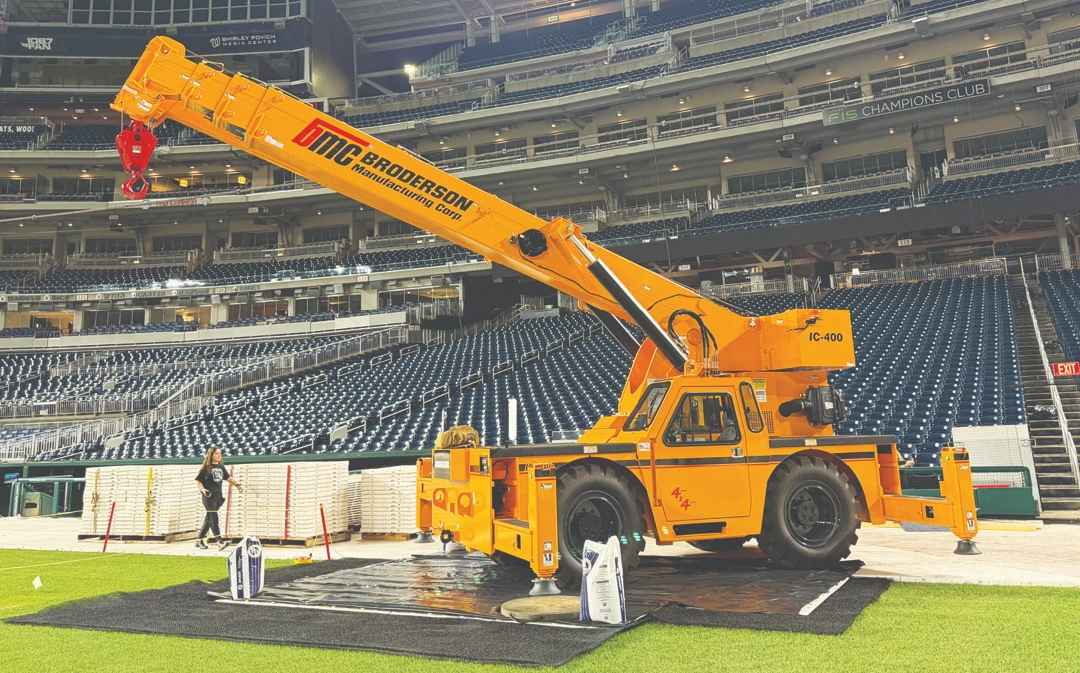
Operator comfort in the IC-400 was addressed with an all-weather climate-controlled cab that features expanded shoulder, leg, and headroom. Ergonomically designed electronic controls and fatigue-reducing joystick systems are also part of the crane’s design.
While diesel-powered carry deck cranes remain common, electrification is steadily gaining momentum in certain industrial applications. JMG Cranes offers a range of fully electric carry deck cranes that can work for up to eight zero emissions hours without interruption. JMG’s MC 100RE model offers a maximum lifting capacity of more than 10 tons.
Manitowoc serves the carry deck segment through two distinct product lines: Shuttlelift Carry Deck (SCD) and Grove Carry Deck (GCD). Each family consists of four models with capacities that range from 9 to 25 tons. The flagship GCD25/SCD25 features a 71-foot boom and an optional 17-foot offsettable swingaway extension and can deliver a maximum tip height of 95 feet.
The GCD25/SCD25 machines have four-wheel drive and four-wheel steering systems for congested jobsite maneuverability, and a four-position pivoting boom head for versatility. A recently added optional multi-camera package, the manufacturer pointed out, improves operator visibility and supports safety.
One distinguishing characteristic of Shuttlelift and Grove carry deck cranes is the availability of a dual-fuel option, which gives customers the flexibility to work both indoors and outdoors.
Strong Fundamentals
According to Jacob Dunning, product manager industrial cranes at Manitowoc, the outlook for the carry deck crane market remains strong. “Infrastructure projects, expansions of warehouse and distribution centers, and the maintenance of manufacturing facilities and utility plants are driving the demand for carry deck models,” he said. “High rental utilization rates and aging customer equipment fleets are also contributing to market demand.”
Carry deck cranes occupy a niche that few other machines can effectively serve. They combine lifting capability, transportation functionality, and maneuverability in a single package, making them valuable in applications where larger cranes would be impractical or inefficient. At the same time, technological improvements such as telematics, advanced safety systems, and enhanced visibility packages are helping address changing customer expectations.
Those factors suggest that carry deck cranes will continue to play a critical role in industrial lifting operations where these highly maneuverable machines remain uniquely positioned to meet the growing need for efficient lifting in confined spaces. As manufacturers continue introducing new models and innovations, the carry deck crane market appears well equipped to support the next generation of industrial and construction projects.