Lifting a New Era
Mobile construction cranes are growing in popularity across the U.S.
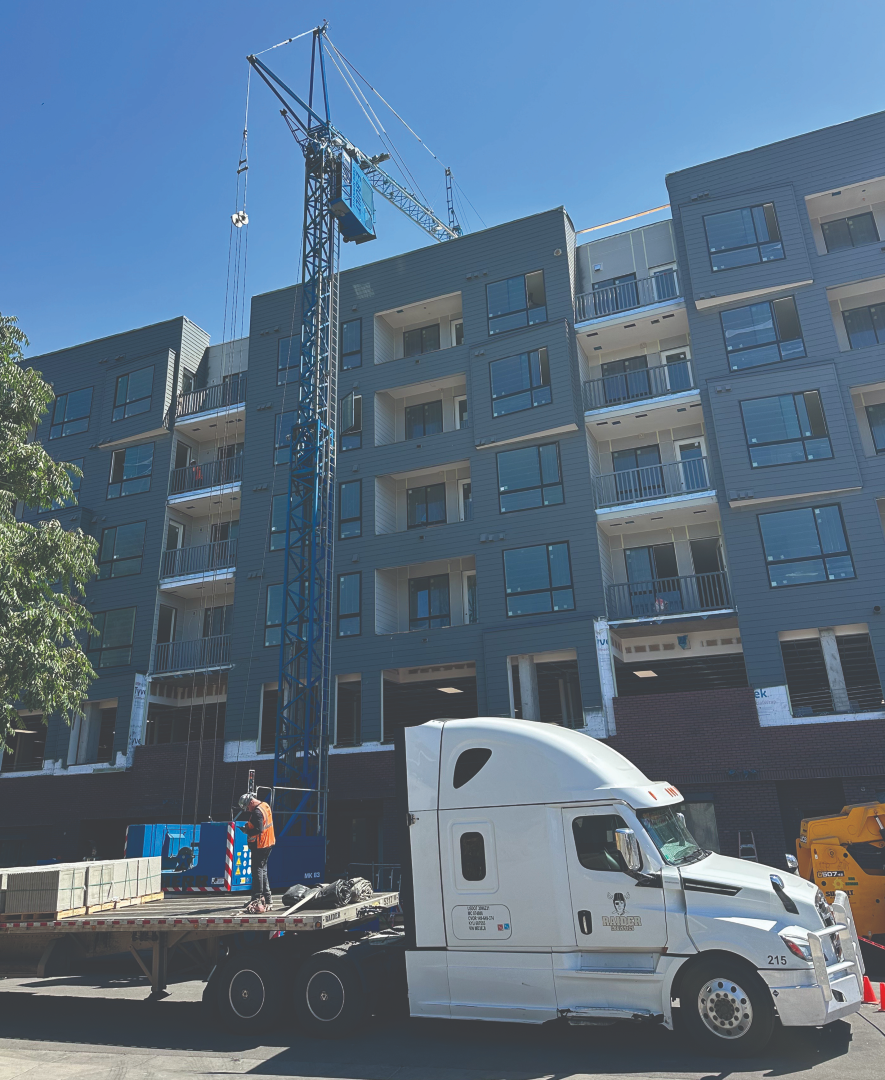
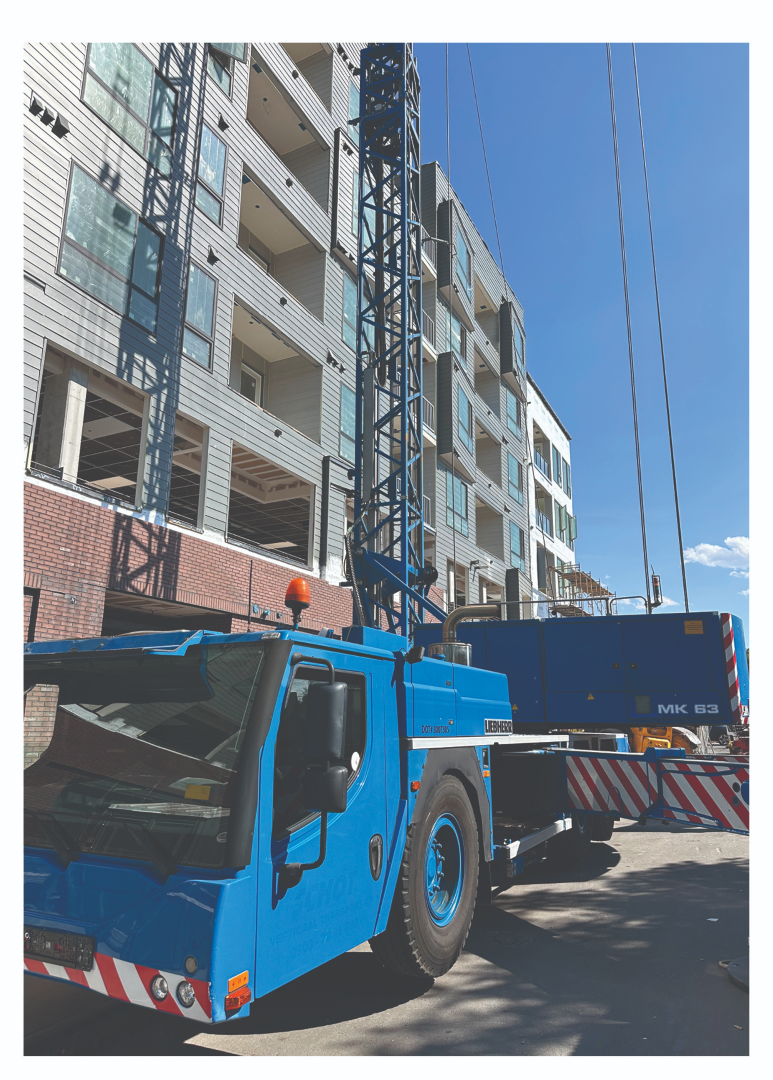
When E-Built Crane Service’s Liebherr MK63 rolled into Denver, Colorado, it didn’t take long for Eric Watson and his team to realize they were working with something special. “Our ‘new to us’ Liebherr MK63 has arrived in Denver,” Watson shared proudly. “We’re setting 2,250-pound pallets of pavers inside a pool area at 118 feet.”
On that project — a six-story residential building with a central pool courtyard — the MK63 was a clear game changer. Surrounded on all sides by the structure, with no ground-level access to the pool area, traditional lifting methods weren’t an option. Instead, the E-Built crew picked the pallets directly from a truck parked on the street, swinging loads over the building and into the enclosed courtyard below. “We did over 50 picks in less than eight hours,” Watson said. “It’s a lot easier and safer than doing that by hand.”
During the lifts, the operator had line-of-sight from the edge of the roof to the drop zone, communicating with crews below by radio to guide each load precisely into place. “They’d call off trolley out and cable down,” Watson explained. “It’s smooth, precise work — and the crane makes it easy.”
Increased Use
That kind of efficiency is exactly what’s happening across the U.S. as mobile construction cranes, also known as self-erecting tower cranes, are increasingly used on jobsites.
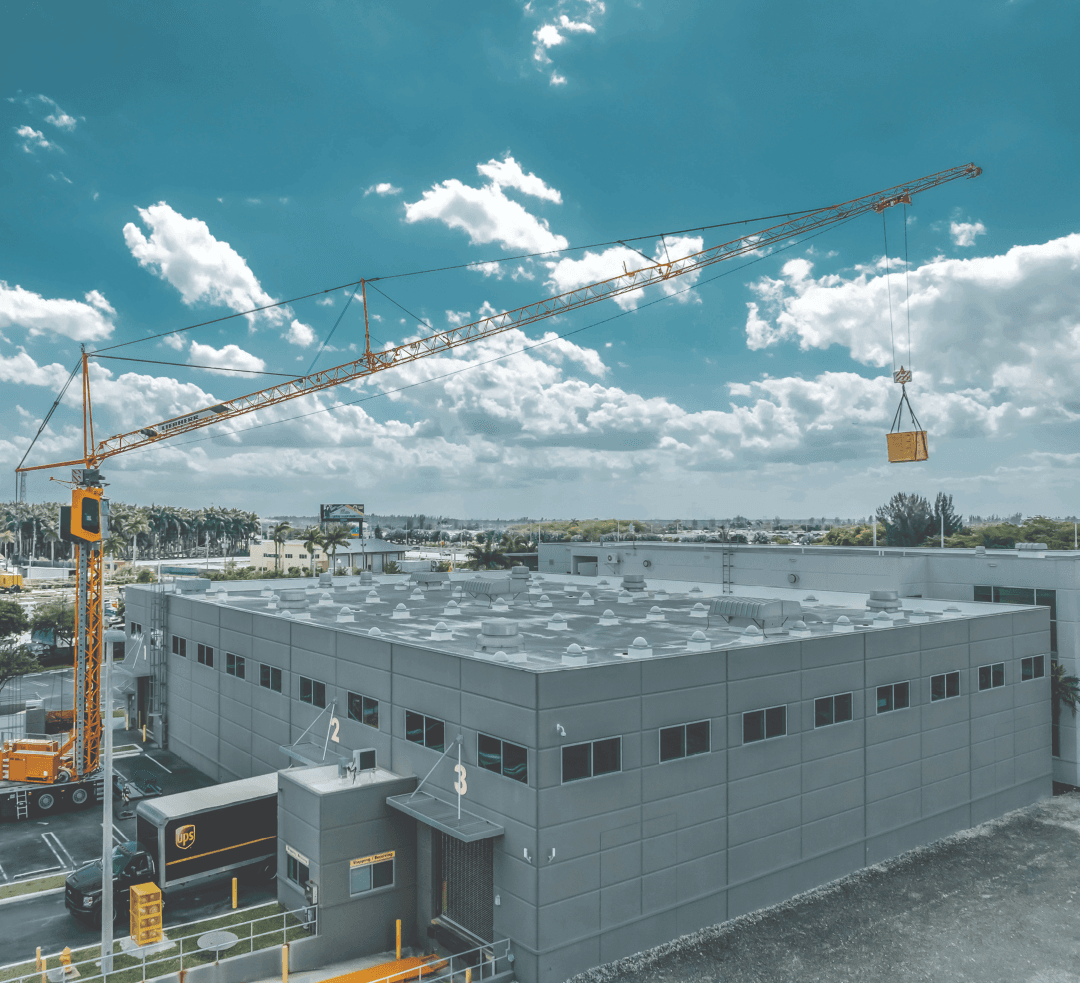
The Liebherr MK63, like the larger MK series cranes now arriving in the U.S., combines the height and reach of a tower crane with the maneuverability and mobility of a truck crane. Setup takes minutes rather than hours — or in some cases, days.
On the Denver site, E-Built’s operator rolled in, leveled the crane with a single button, switched to “erect mode,” and watched as the crane unfolded itself in a series of 174 precise, automated steps. Proximity sensors ensured every movement was aligned and locked before the next sequence began.
“The crane just does it,” Watson said. “You shut off the lower engine, switch to the generator for the upper 480-volt system, and it self-levels and erects itself. You just pull the trigger. It’s incredibly efficient.”
The MK63’s air-cooled Deutz diesel generator keeps things quiet and compact, and it can also be plugged into shore power for near-silent operation — a big advantage for urban or noise-sensitive projects.
Early Adopters
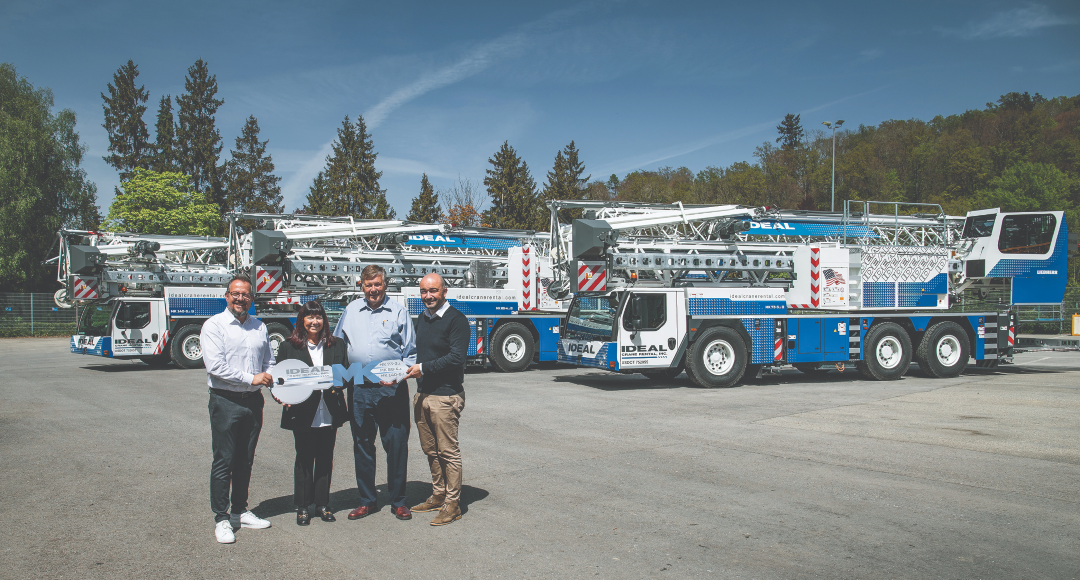
While E-Built is one of the early adopters of Liebherr’s smaller mobile construction cranes, Ideal Crane Rental in Wisconsin and SL Chasse Steel in New Hampshire are among the first U.S. companies to take delivery of MK 73-3.1, MK 88-4.1 and MK 140-5.1 models.
For Robert Kalhagen, president of Ideal Crane Rental, Inc., it’s been a decade in the making. “We first saw the MK series in action over ten years ago,” Kalhagen recalled. “We’ve been eager to utilize this type of crane in the United States ever since.”
Ideal ordered one of each model as soon as Liebherr opened the U.S. market in 2024. “Tasks that previously required a larger crane with multiple counterweights and jib extensions can now be managed with a crane that carries its own counterweights and can be set up in a fraction of the time,” Kalhagen explained.
Ideal’s cranes are scheduled for a diverse range of projects — from HVAC and roofing work to steel erection, solar installation and infrastructure upgrades. Their largest model, the MK 140-5.1, has a reach of more than 200 feet and a hook height of up to 309 feet, and it’s fully operational in less than 30 minutes.
In New England, SL Chasse Steel, based in Hudson, New Hampshire, took delivery of its own Liebherr MK 88-4.1 to serve mid-rise projects in space-constrained areas of the state and in Massachusetts.
“The MK 88-4.1 has exceptional versatility and rapid deployment capabilities,” said Stephen L. Chasse, president of SL Chasse Steel. “The key advantage is its ability to be positioned close to a building and operate in tight spaces where a standard mobile crane cannot.”
That capability is especially valuable for the company’s work on four- to six-story timber-frame residential buildings using prefabricated panels where every inch of street space counts.
SL Chasse’s MK 88-4.1 features a 99-foot standard hook height, 193-foot maximum hook height and a 4,850-pound capacity at a 147-foot radius. It’s powered by Liebherr’s hybrid system, allowing electric or diesel operation, and offers the same 30-minute setup advantage that’s quickly redefining what’s possible on urban sites.
Long History
Liebherr’s history with mobile construction cranes dates back over half a century. The concept first emerged in 1961, when the company introduced fast-erecting cranes of the former KA series mounted on a truck chassis, a combination that laid the groundwork for today’s MK line.
The current MK series now available in the United States includes the MK 73-3.1E, MK 88-4.1E, MK 120-5.1E and MK 140-5.1E models. All are hybrid-powered and can operate silently when connected to site power, an increasingly important advantage for sustainable, low-impact construction in populated areas.
The MK cranes are purpose-built for urban environments, where narrow streets, congested sites and strict noise limits challenge conventional lifting equipment. Because they can be positioned directly next to buildings, the need for lane or road closures is often eliminated.
Each model can be driven, set up and operated by a single person, improving fleet efficiency and reducing crew requirements. Once on-site, the crane’s intelligent control system automatically recognizes its configuration, guiding the operator to safe working limits and minimizing setup errors.
Safety is at the forefront. Automated assembly and disassembly sequences, advanced camera systems and a height-adjustable operator cabin provide visibility and control. Even transport is simplified by multiple driving modes, a reversing camera and an expansive windshield.
For projects near hospitals, schools or residential areas, Liebherr’s mobile construction cranes offer a quiet solution. Each crane can be plugged into an external power source, allowing full operation without running its diesel engine.
This near-silent operation is a major selling point for contractors performing nighttime work or projects with noise restrictions. Combined with zero on-site emissions when running on electricity, it aligns perfectly with the growing emphasis on sustainability in construction.
The MK series’ versatility extends across multiple sectors. From bridge and roof building to solar panel installations, prefabricated housing and plant maintenance these cranes provide a compact yet powerful lifting option. And because they can travel between jobsites quickly — fully road-legal and ready to operate within minutes — they perfectly fit the modern contractor’s demand for flexibility and uptime.
Behind The Scenes
Liebherr USA offers a 24/7 service hotline for its mobile and crawler cranes, resolving more than 85% of technical calls remotely without dispatching a technician. When on-site support is needed, dedicated MK technicians are available nationwide.
Liebherr also conducts hands-on training for customer technicians. Courses cover everything from the crane’s control system to full erection and dismantling procedures. These programs ensure every operator and mechanic can keep Liebherr equipment performing safely and efficiently.
From E-Built’s six-story rooftop paver job in Colorado to Ideal Crane’s Midwest deployments and SL Chasse’s urban steel projects in New England, Liebherr’s MK cranes are proving their worth in vastly different environments. What unites these stories is the realization that self-erecting tower cranes represent a new category in the U.S. lifting market.
As Eric Watson summed up after a long day of precise lifts in Denver: “It can go as high or as low as you need, and the operator has a clear line of sight to the crews. It’s safe, it’s easy and it gets the job done faster. Once you use one, you won’t want to go back.”