Jobsite Versatility
Truck cranes offer lifting capacity and flexibility in a single machine
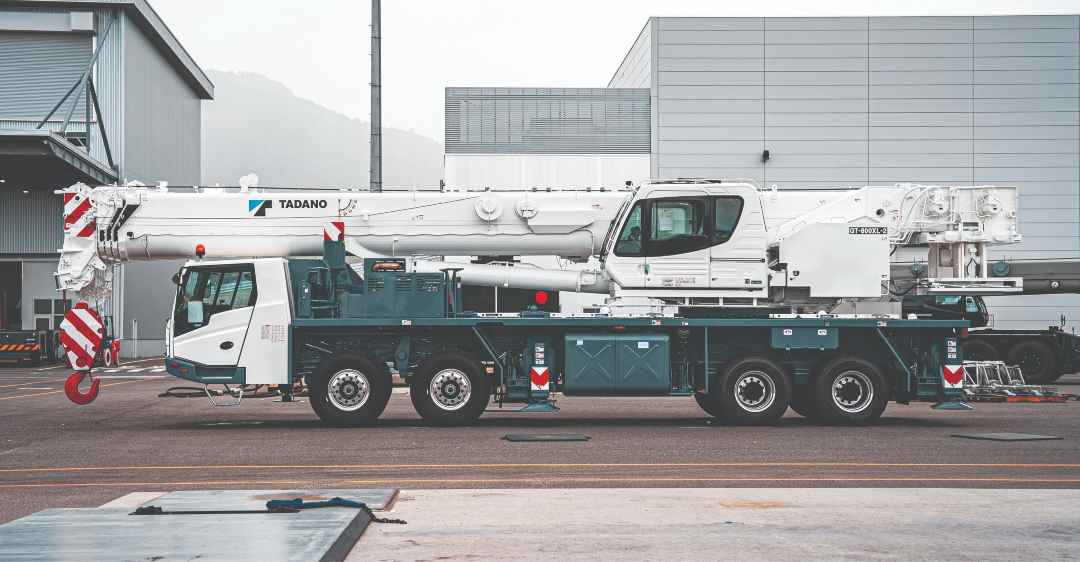
Across the board, manufacturers of truck cranes are upbeat about the market for machines that are comfortable to drive and easy to set up and operate. Price, reliability, and a range of configurations that offer the ability to carry the most counterweight and still meet axle weight regulations, continue to make truck cranes a highly viable option for customers that do not need off-road capability.
“We expect the truck crane market to remain strong throughout 2026, as large-scale construction projects continue and customers look to add new cranes to aging fleets,” said Brandon Robinson, product manager for telescopic trucks and all terrain cranes at Link-Belt. “Demand in multiple sectors continues to contribute to consistent truck crane usage in North America.”
Lance Rydbom, vice president of product management & engineering at Tadano, pointed out that the truck crane market has been solid across all sectors. “Fleet replacement and oil and gas industry needs have been major drivers,” he said. “The near future looks good for these machines.”
“The North American truck crane market remains generally steady, supported by ongoing investment in infrastructure, utilities, energy, and industrial projects,” said JJ Grace, product manager for truck-mounted cranes at Manitowoc. “While demand continues across the full range of capacities, the strongest activity is occurring in the 90 plus ton segment, where customers are seeking greater lifting capability and jobsite versatility from a single machine.”
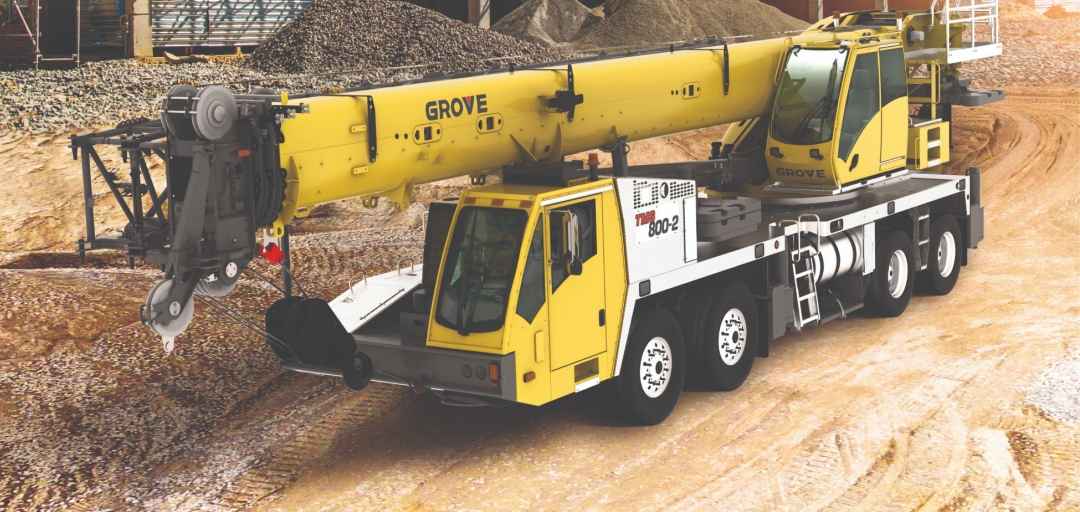
All current Grove TMS truck crane models are available with personnel platforms that enable both lifting and crew access with a single machine.
Meeting Needs
“One of the most significant innovations in our newest truck crane models is the availability of personnel platforms on all current production Grove TMS models,” Grace continued. “This technology was initially developed to meet the needs of the energy and infrastructure sectors. However, its appeal has expanded well beyond those markets, with growing interest from utilities, industrial maintenance, and general construction customers.
“By enabling both lifting and personnel access with a single machine, customers can improve jobsite efficiency, increase equipment utilization, and potentially reduce the need for additional specialized equipment, delivering greater value and flexibility from their truck crane investment,” Grace added.
Truck crane owners are focused on reliability and transportability and emphasize maximizing utilization when making equipment choices, Robinson noted. “To meet these needs, we engineer truck cranes based on North American on-highway transportation requirements, utilizing modular counterweight configurations to minimize setup time and the number of required overflow loads,” he said.
“Some of our newest truck crane features are the Link-Belt Pulse 2.0 operating system, Variable Confined Area Lifting Capacities (V-CALC) to allow for variable outrigger positioning, and the SmartFly system that requires only one operator working from ground level to erect the fly,” Robinson continued. “All Link-Belt truck cranes also feature on-highway compliant Cummins diesel engines, our Site Vision Package to enhance safety on busy jobsites, and features like air disc brakes, a tire pressure monitoring system, and SmartStack counterweight detection.”
At Tadano, according to Rydbom, truck crane model development is focused on core capabilities enabling them to excel in taxi service. “For example, by offering 65-mile-per-hour capability, our truck cranes are agile,” he said. “They perform well logistically as they go from job to job and help enable efficient deployment of equipment.”
Model Ranges
As the three manufacturers offering truck cranes in North America, Grove, Link-Belt, and Tadano provide a range of options, including:
Grove
- TMS875-2 — 75 tons, main boom length 40 - 128 feet, maximum tip height 194.3 feet
- TMS800-2 — 80 tons, main boom length 40 - 128 feet, maximum tip height 194.3 feet
- TMS9000-2 — 115 tons, main boom length 36 - 169 feet, maximum tip height 263.4 feet
- TTS9000-2 — 115 tons, main boom length 36 - 169 feet, maximum tip height 263.4 feet
Link-Belt
- 40|HT — 40 tons, standard boom 36.8 – 115 feet, maximum tip height 171 feet
- 65|HT — 65 tons, standard boom 36.8 – 115 feet, maximum tip height 171 feet
- HTC-8675 SII — 75 tons, standard boom 41– 127 feet, maximum tip height 230 feet
- HTC-86100 — 100 tons, standard boom 38 – 140 feet, maximum tip height 237 feet
- HTC-86110 — 110 tons, standard boom 38.3 – 164.1 feet, maximum tip height 262 feet
- 120|HT — 120 tons, standard boom 38.3– 164.1 feet, maximum tip height 262 feet
- 120|HTLB — 120 tons, standard boom 39.8– 196.9 feet, maximum tip height 263 feet
- HTT-8675 Series II — 75 tons, standard boom 41 – 127 feet, maximum tip height 230 feet
- HTT-86100 — 100 tons, standard boom 38 – 140 feet, maximum tip height 237 feet
- HTT-86110 — 110 tons, standard boom 38.3– 164.1 feet, maximum tip height 262 feet
- 120|TT — 120 tons, standard boom 38.3 – 164.1 feet, maximum tip height 262 feet
- 120|TTLB — 120 tons, standard boom 39.8 – 196.9 feet, maximum tip height 263 feet
Tadano
- GT-800XL-2 — 80 tons, main boom 39.5 – 154.3 feet, maximum boom length 154.3 feet
- GT-1200XL-2 — 120 tons, main boom length 41– 167.3 feet, maximum boom length 167.3 feet
“As contractors look to improve productivity and maximize equipment utilization, higher-capacity truck cranes are becoming increasingly attractive solutions,” Grace said. “Industry trends such as infrastructure modernization, grid expansion, renewable energy development, and labor shortages are also influencing purchasing decisions, with customers prioritizing truck cranes that help them complete work more efficiently while maintaining flexibility across a wide range of applications.”
Tandem Lift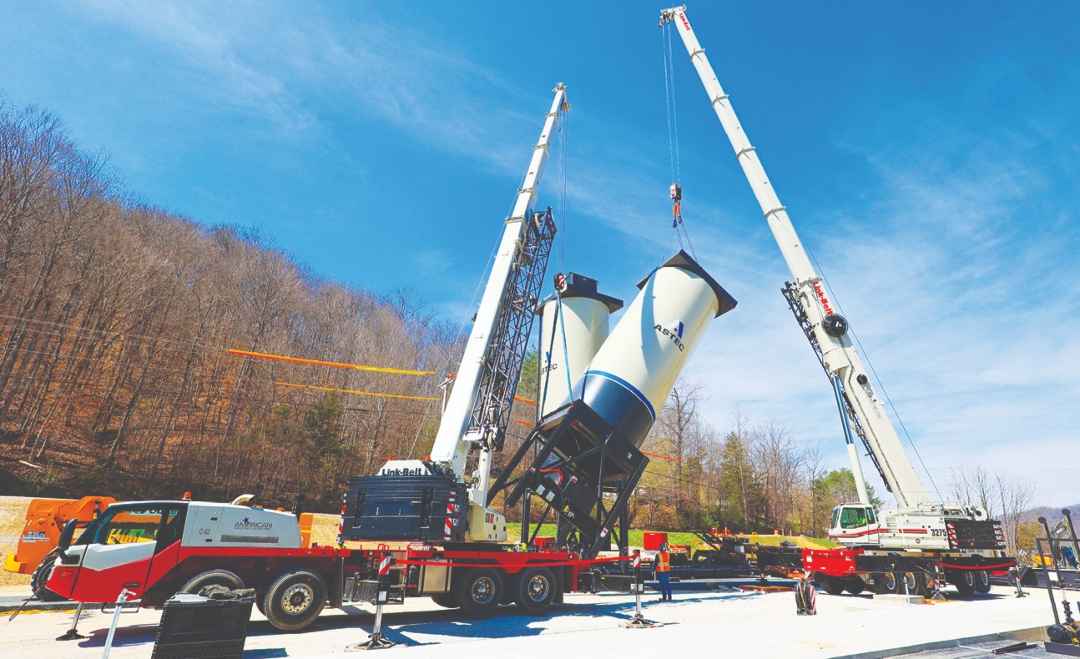
Using Link-Belt 120-ton 120HT truck crane and 275-ton ATC-3275 all-terrain models, American Industrial Contractors of Lexington, Kentucky assembled a new ASTEC asphalt plant at Hinkle Contracting’s Natural Bridge Stone Co. To upgrade the hot mix asphalt plant serving central and eastern Kentucky, two cranes were used in tandem to lift several large components, including silos and tanks.