Delivering Productivity
Boom trucks are helping improve operations on construction and other jobsites
The range of boom trucks offered by industry suppliers includes an impressive array of models designed to meet a variety of lifting and project needs. The manufacturers are also focused on providing key features and technological advancements.
“Our National Crane boom truck product line offers operators several key features to improve jobsite performance,” said Bob Ritter, product manager. “There are roadable counterweight configurations to meet any requirements. The machines have control systems with on board diagnostics and truck error code monitoring and visibility options like hoist, rear view and offside camera options, wireless outrigger controls and windspeed monitoring.”
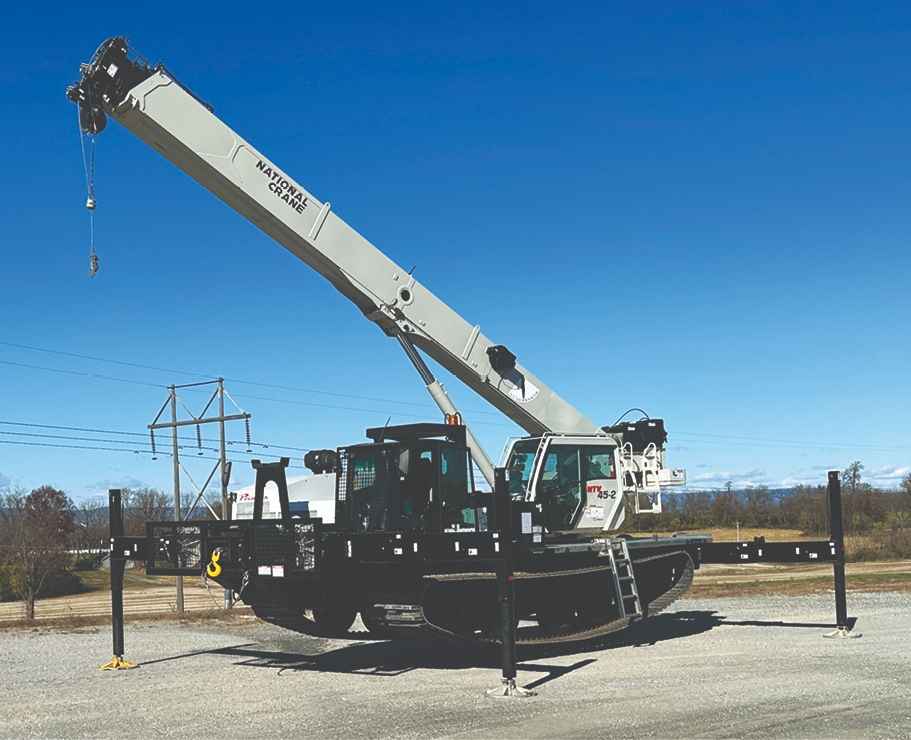
At National Crane, the boom truck product line consists of 24 models ranging from 10- to 60-ton capacities with maximum tip heights from 66 to more than 200 feet. Recently, the company launched their new National Crane NTV45-2 model, a 45-ton capacity crane mounted on a tracked Prinoth T22 chassis. The crane is equipped with a 142-foot main boom and is capable of a 200-foot platform height.
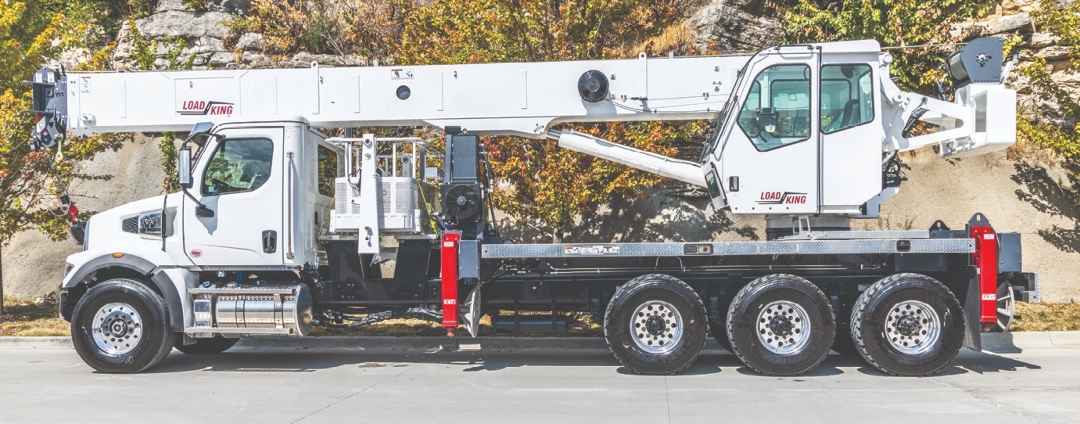
At Load King, John Lukow, senior vice president, cranes, said the company has implemented A92.2 charts for all crossovers to facilitate the most efficient basket work possible. “We have also added asymmetrical outriggers to allow for fitting the crane in tight spaces and have replaced proximity switches with magnetic sensors in our outriggers to improve reliability,” he added.
New Load King models this year include the 22-51TM, 25-92RM, 19-70M and upgraded 35M and 35/40RS units, as well as the 40-142RS with the tilt cab and control system from crossovers. The company’s boom trucks are manufactured in a purpose-built crane assembly facility with a new machining and welding center and new wet paint and powder coat systems.
“At Elliott Equipment we continue to push the limits of utility construction technology with our new self-leveling, rotating material-handling platform, now available on E-Line aerials with 145-, 160- and 190-foot tip heights,” said Jim Glazer, president & CEO. “While many long-boom cranes rely on gravity-leveled platforms, this design brings a smarter, safer and more productive solution to high-reach applications.”
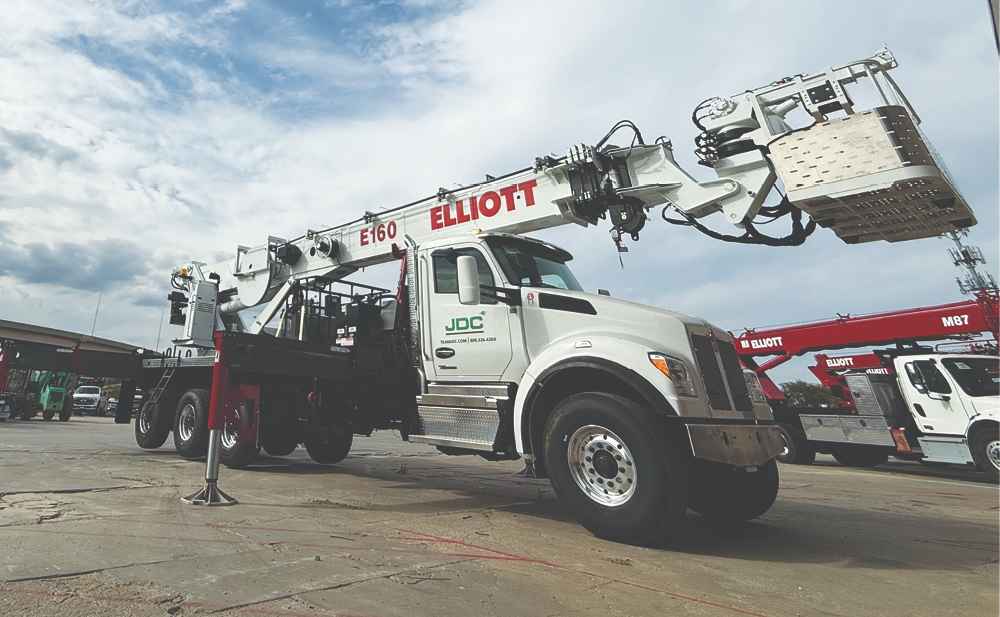
The self-leveling platform from Elliott, Glazer explained, keeps operators optimally positioned. It also features a hydraulically telescoping and rotating material handler rated for 1,500 pounds, enabling precise load placement without additional rigging. Because the platform can remain mounted during boom transport as well, crews save time setting up and tearing down on jobsites. Fully compliant with ANSI A92.2, the system also eliminates the need for OSHA-required trial lifts and proof tests.
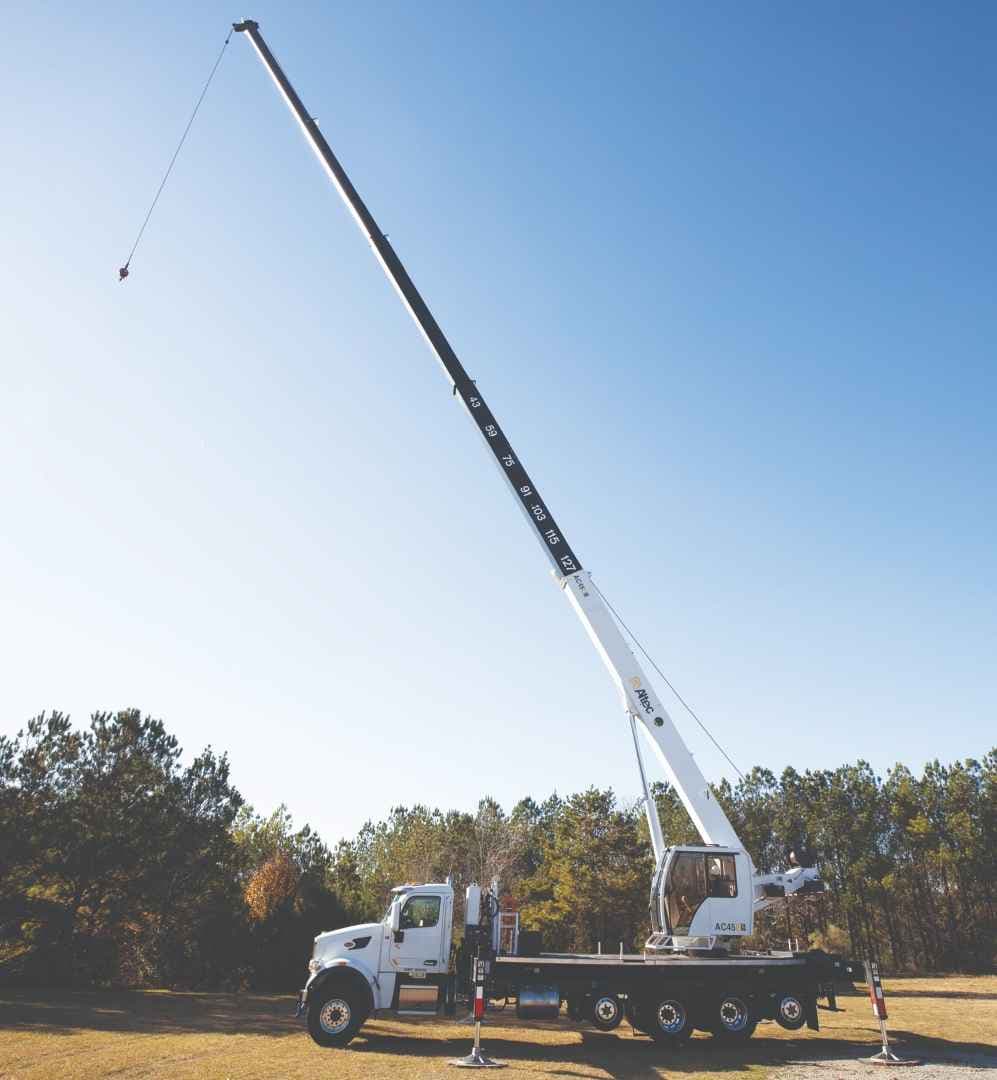
Ryan McGiboney, market manager at Altec said that the luffing jib technology on the Altec AC65E-155S offers a hydraulically powered articulating jib that is fully controllable from the operator’s cab. The luffing jib also provides for 105 feet of platform side reach in aerial mode. “This technology allows for faster setup and better up-and-over access, and it removes the need to estimate the offset needed for a particular lift,” he explained.
Altec AC40E and AC45E boom truck cranes can feature a Category A insulating personnel jib with integrated leakage monitoring for barehand work applications. All of the company’s models are dual rated to ASME B30.5 and ANSI A92.2 standards, meaning they are both boom truck cranes and aerial devices when configured for platform mode.
Models in the Altec lineup include the AC40E-152S, the AC45E-127S and the AC65E-155S. Both the AC40E and AC45E are offered in a track variant on the Prinoth T22. The AC40E is primarily used as a high-reach aerial device because of its platform working height and transmission features, McGiboney related.
The smaller and lighter AC45E is more suited for tree care, construction, heavy substation and transmission work where the structure heights aren’t very tall, McGiboney added. The AC65E has more reach than the AC40E and more capacity than the AC45E. It is offered in full-counterweight and a federal bridge law compliant configurations.
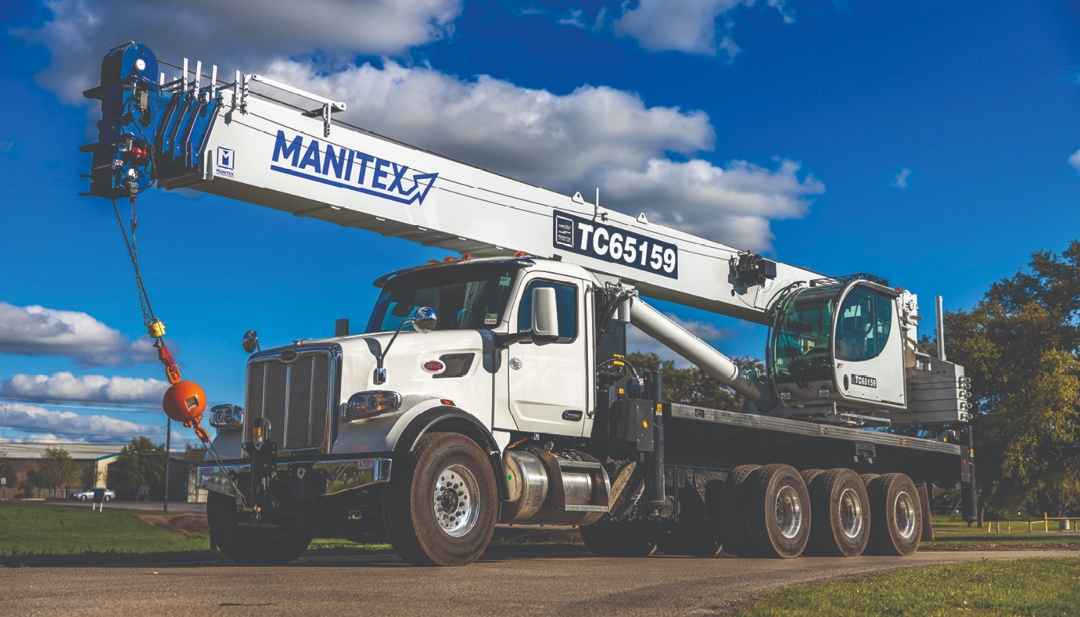
Randy Robertson, director, inside sales at Tadano America Corporation, related that the company’s Manitex TC series machines have a 40- to 65-ton self-leveling feature. The manufacturer’s product line range includes boom trucks from 19 to 65 tons of capacity.
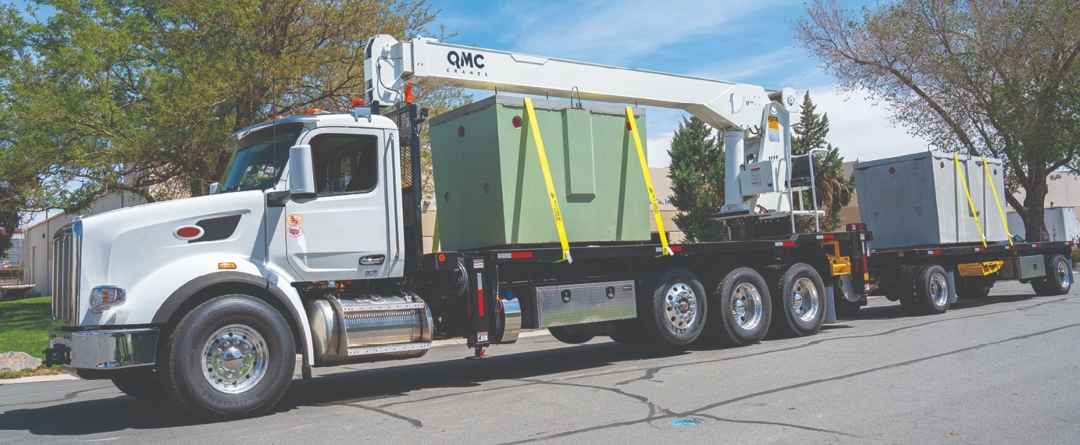
Scheduled for a formal introduction in 2026, according to Craig Schumacher, technical sales representative, is an entirely new boom truck crane from QMC Cranes. The company has also designed a new pup trailer to add to the carrying capacity of their line of boom trucks.
“We offer a variety of non-CDL truck mounted cranes with capacities ranging from one to 15 tons and up to 102 feet of tip height,” said George Schalk, VP sales at Smiley Lifting Solutions. “We can also custom build a truck mounted crane to suit your needs.”
Market Outlook
Altec has seen increased demand in the utility transmission construction and maintenance markets, noted McGiboney. “In those segments, the boom truck market is seeing high growth and increased sales volumes,” he said. “One of the reasons is because the market is used to machines mounted on vocational chassis.
“The growth period we are in for the electrical grid is also driving up boom truck sales volumes,” McGiboney added. “Transmission demand is high in response to historic load growth with the explosion of data centers to support AI, cloud computing services and other emerging technologies. On top of greenfield construction, most utilities have increased their spending on line voltage upgrades, storm hardening and fire hardening as ways to increase grid capacity and resiliency.”
Load King’s Lukow said the boom truck market will be flat through 2025 because general construction is down while oil and utility transmission activity is up.
“It is difficult to predict the upcoming boom truck market due to rising and uncertain truck pricing,” said Schalk. “It also seems that the used crane market is stronger than the new crane market, which is likely due in part to increasing truck prices.”
For Schumacher, 2026 will be a big year for the boom truck market in general. “Our quotation volume has been up 60% from 2024 but so far the high capital cost along with the tariff impacts have resulted in delayed sales,” he said. “Another current factor is that customers are repairing fleets instead of replacing because of economic uncertainty.”
Robertson said boom truck growth will benefit from rising demand for high reach transmission line construction and maintenance machines.
“We project boom truck demand to remain strong through 2026, driven by continued utility transmission construction, rental fleet replacements and steady activity in commercial construction,” said Glazer. “Federal and state infrastructure funding, along with ongoing utility investment, is keeping project pipelines healthy across regions.
“While financing costs remain a consideration, overall fleet confidence is solid,” Glazer continued. “Dealers and fleet managers are focusing on total cost of ownership, reliability and lifecycle support, a good sign for manufacturers who deliver maximum uptime through robust parts availability, responsive service and comprehensive warranty programs.”
Boom Trucks on the Job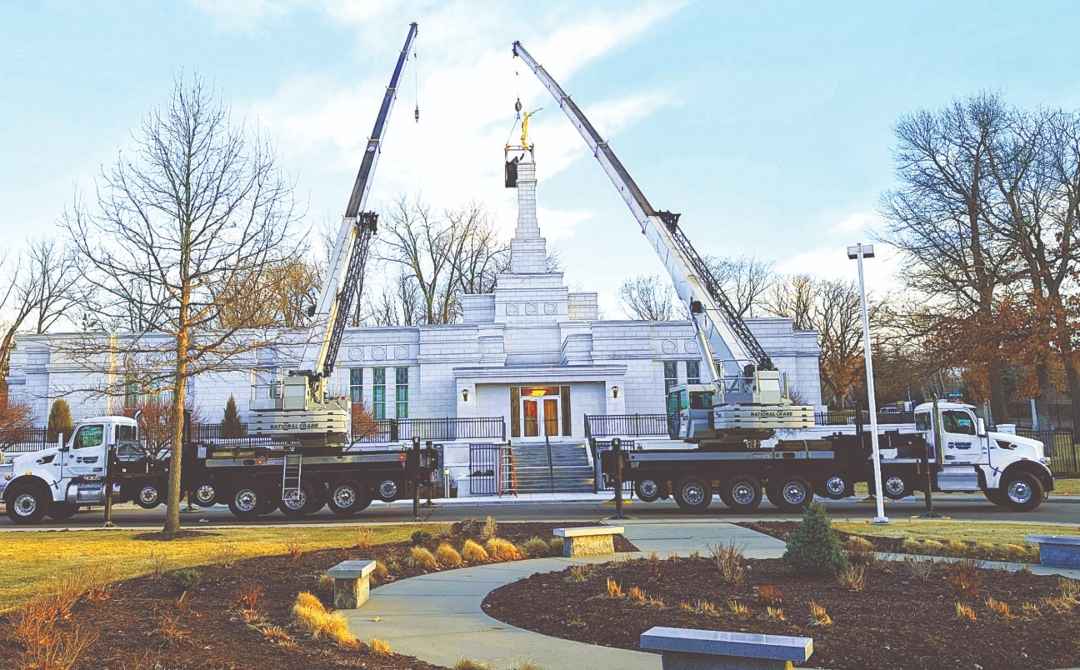
When Northland Crane Service was called on to help replace a 1,200-pound statue of an angel at the top of a popular church temple in Oakdale, Minnesota, the company met the challenge with two National Crane NBT60XL boom trucks. For the project, one of the boom trucks lifted a crew member in a basket to rig the lift while the other lifted the statue.
“Both boom trucks were set up with 150 feet of main boom,” said Erik Peterson, owner of Northland Crane Service. “We needed the NBT60XL’s 60-ton capacity at that boom length, and it streamlined planning with both machines being the same model. By using the NBTs, we could set up in the church driveway and avoid the grass and still lift strongly from that distance. We were in and out in three hours.”
Northland Crane Service, an Elk River, Minnesota-based company, operates ten National Crane boom trucks supplied by MGX Equipment Services. Included are NBT1300A, NBT45-2, NBT55L and NBT60XL cranes.
When Felix Tree Experts required a boom truck built to match the demands of daily tree operations, from residential removals to complex, high-reach jobs, the company turned to High Caliber Cranes, LLC, based in Selinsgrove, Pennsylvania for a custom XCMG XCT35 model.
The XCT35 for Felix Tree Experts was assembled at the High Caliber facility. The boom truck has a 35-ton capacity, a 120-foot main boom and a 29.8-foot jib and is fitted with a lift axle. During delivery and familiarization, Carolina Crane & Tree joined Felix Tree Experts for hands-on training, safely removing two trees that were threatening nearby property.
XCMG’s current crane lineup for the U.S. market includes boom trucks from 35 to 60 tons.