CONEXPO 2026 Crane and Lifting Equipment Highlights
Innovations, upgrades and standout equipment from North America’s top trade show

North America’s largest trade show, CONEXPO-CON/AGG, returned this year to Las Vegas, Nevada. According to the show producer, the Association of Equipment Manufacturers (AEM), this event hosted more than 2,000 exhibitors, 140,000 attendees and three million square feet of show space.
Equally impressive were the new machines, technology and innovations on display. From crawlers and training systems to carry decks and crane tires, the latest equipment reflects the ingenuity shaping the future of the industry.
PVE American
PVE American, Inc. showcased the CC200-1, a 200-ton lattice boom crawler crane introduced to the North American market in January 2026.
The crane complies with ANSI/ASME B30.5 and is powered by a 355-horsepower Cummins L9 diesel engine that meets Stage V and Tier 4 Final emissions standards.
Safety features include foldable upper guardrails, side platforms with guardrails, roof protection and additional 360-degree safety platforms. The crane also incorporates front and rear access ladders, side access steps with a handrail and a physical angle display.
The CC200-1 is equipped with sealed, oil-filled track rollers, chain-mounted flat track shoes and hydraulic track drives designed for multiple travel speeds. Standard features include a boom stack system that allows operators to stack boom sections without additional materials, along with boom pendants and boom pin storage designed to keep pins secure during transport and ready for use.
The crane was developed from the ground up and includes non-privatized hydraulics, electric controls, remote troubleshooting capabilities and a programmable joystick. A 360-degree camera system mounted at the top of the boom provides camera views around the machine and includes pedestrian signaling.
XCMG
XCMG displayed several cranes, including the new XCT45_U boom truck, along with the XCR130U rough terrain crane and the XCA275U all-terrain crane.
The XCT45_U boom truck was among the newest models on display. The crane has a 45-ton lifting capacity and a 142-foot main boom, paired with a 30.5- to 53.5-foot offsettable jib. The unit is mounted on a Peterbilt 567 chassis and powered by a Cummins X15 engine. An optional wireless reel is also available.
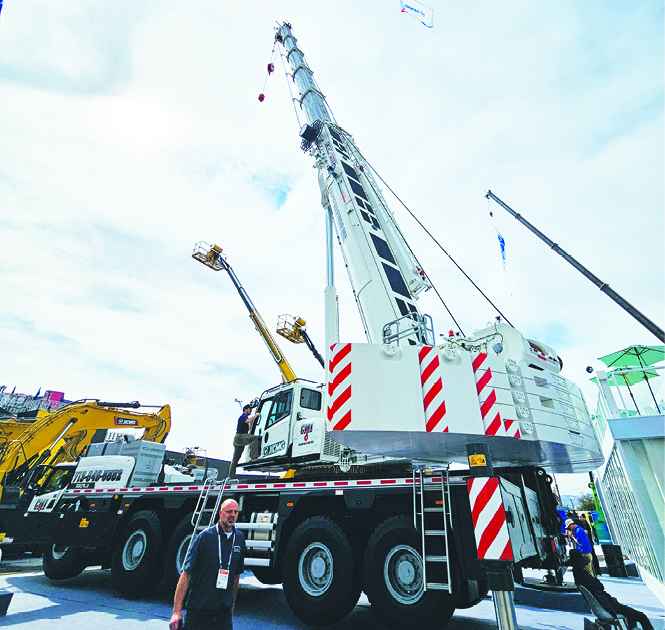
Also shown was the XCR130U rough terrain crane. The model offers a maximum lifting capacity of 130 tons and a five-section boom reaching 164 feet. With a jib installed, the maximum boom and jib combination extends to 224 feet. The crane has multiple steering modes, including crab steering, and features a touch-screen operation display along with integrated camera views to monitor winches and the boom tip.
The company also displayed the XCA275U all-terrain crane. The five-axle machine has a maximum lifting capacity of 275 tons and a seven-section boom measuring 239.5 feet, with jib options ranging from 32.8 feet to 147.63 feet.
Manitowoc Company
Manitowoc Company introduced the Grove GMK8700 all-terrain crane, the largest all-terrain crane in the Grove lineup to date, expanding the Grove range of cranes from 55.13 to 800 tons. The eight-axle crane offers an 800-ton lifting capacity and was developed to meet growing demand for heavy-lift applications across infrastructure, industrial and energy projects. The GMK8700 features two boom options, a maximum luffing jib length of 351 feet, the MegaWingLift capacity-enhancing system and Manitowoc’s next-generation CCS 2.0 crane control system integrated with the Grove CONNECT telematics platform.
Also new to the stage, National Crane introduced the NTC80 boom truck. Developed from field feedback, the NTC80 delivers 80 tons of lifting capacity on a commercial, roadable truck chassis.
The crane features a modular, trayless counterweight system, four-position outriggers with a 24-foot full-span setup and a 37- to 61-foot bi-fold swing-away jib with adjustable offsets for versatile lift geometry. An updated operator cab enhances visibility and comfort, while serviceability is improved through multiple ladder access points, a pullout catwalk and an integrated hoist access platform.
Manitowoc also had the new Mobile Training & Technology Center mobile classroom on display, offering a fully equipped on-site training classroom in a transportable module.
Liebherr
Under the theme, “Hands on the Future,” Liebherr showcased several new or updated crane models, including the self-erecting K series tower cranes, newly introduced to North American markets.
The K series offers compact transportation, high lifting performance and quick setups in residential, mid-rise and commercial projects. They provide small footprints, variable hook heights, telescoping towers and multiple jib configurations and feature sway control plus, guided hook, vertical line finder and positioning pilot intelligence assistance systems for smoother lifting and semi-automated operation. The 91 K, on the ground at the event, features a maximum hook height of 133 feet, a maximum load capacity of 13,240 pounds and a radius up to 157.5 feet.
The LTM 1090-4.3 mobile crane featured the new LICCON3 control system and updated crane and driver cabs. Updates include higher lifting capacity on the telescopic boom, driver assistance systems, touch-screen controls, improved LED lighting and automatic climate control. It retains variable axle loads, VarioBallast and VarioBase, with added features such as blind spot and moving off information, plus optional lubrication and tire monitoring.
The LR 1400.1 SX crawler crane was shown with derrick equipment and suspended counterweight. The setup increases capacity with long booms and luffing jibs. It includes VarioTray, position monitoring, boom assistant and ground pressure monitoring.
Broderson Manufacturing
Broderson Manufacturing Corp. displayed the IC-400-C 25-ton capacity carry deck crane with the new asymmetric outrigger system. The system allows operators to position outriggers unevenly, increasing lifting capacity in tight spaces and enabling safer lifts in confined jobsite conditions. The updated lift planning tool visually maps capacity zones with color coding, showing safe load limits and increasing capacity to 86% in the green zone. Operators can test different outrigger positions in real time, adjusting for obstacles, maneuvering around equipment or loading vehicles alongside
the crane.
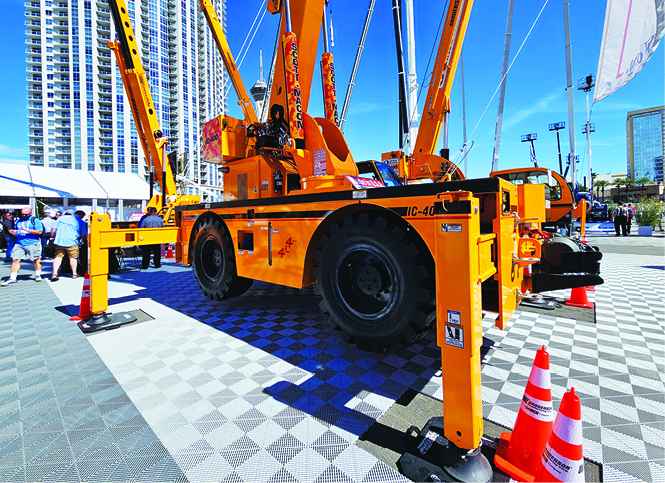
The asymmetric system extends the reach and stability of the IC-400-C without altering the crane’s original design. Operators can maximize outrigger extension on one side to improve lift performance while keeping the opposite side retracted, allowing for longer lifts in limited space. Existing IC-400 models can be upgraded with the new software, while all new IC-400-Cs come standard with the feature.
Link-Belt
Designed to fill a market gap between the 250-ton TCC-2500 and 140-ton TCC-1400, Link-Belt Cranes introduced the 180-ton TCC-1800 telescopic crawler crane. It features a 42.7- to 197.3-foot greaseless six-section pin-and-latch boom, a 55-foot bi-fold hydraulically offsetable SmartFly and up to three 18-foot lattice extensions for a maximum tip height of 314 feet. Power comes from a Stage V/Tier 4 Final Cummins QSB6.7 diesel engine, with an optional auxiliary power unit for cab systems.
The crane includes centralized grease and electrical locations, wireless rigging remote, fall-arrest anchors and swing boundary poles. It also features the Pulse 2.0 rated capacity limiter with a 10-inch touch screen, onboard diagnostics and remote troubleshooting. The undercarriage shares components with the TCC-2500 and introduces independent extension cylinders for variable track positioning and 360-degree lifting charts with pick-and-carry capability.
Link-Belt also showcased the 200-ton 248|V lattice crawler crane. It features the HSL-2 load moment limiter with a 12-inch touch screen and telematics for real-time data, including wind speed, list, trim and ground bearing pressures. Powered by a Cummins QSB6.7 engine, it offers an auxiliary power unit for displays, cameras, lighting and climate control.
The 248|V offers boom lengths from 55 to 285 feet and jib lengths from 30 to 100 feet, with a 20-foot combo top. Updates include a hydraulic counterweight removal system, quick-reeve terminators and a redesigned 25-foot base section.
Tadano
Tadano introduced several new cranes at CONEXPO, expanding its North American lifting portfolio. The 60-ton GTC-600-2 telescopic boom crawler crane replaces the GTC-550. It features a 113.8-foot full-power boom, 28.9-foot extension and 49.9-foot jib, with lifting capacities up to four degrees out of level in full pick-and-carry operations. The crane is transportable on a single truck.
Tadano also displayed the AC 5.250L-2 and AC 6.300-1 all-terrain cranes. The AC 5.250L-2 features a 259.2-foot side-pinning main boom system, a maximum main boom extension of 98.4 feet and a new bi-fold jib measuring 32.8 feet or 62.3 feet, plus a 3.6-foot adapter. All main boom extensions, from 19 to 98.4 feet, are self-erecting. The crane’s counterweight is divided to facilitate transport, and rigging features include remote control, self-leveling outriggers and automatic counterweight handling. The AC 6.300-1 is a 350-ton all-terrain crane with a 262.5-foot main boom. It includes a removable outrigger box to optimize transport and shares many components with other Tadano all-terrain cranes to reduce parts inventory.
Tadano also added PM knuckle-boom cranes to its North American lineup. The models on display included the PM 16524 S, PM 23525 SP PT and PM 65024 SP PT equipped with a J1414.20 fly jib. Their compact working envelope and precise load-handling capabilities make them well-suited for confined or congested jobsite environments.
Spydercrane
Spydercrane, represented in North America by Smiley Lifting Solutions, used the event to highlight updates to its mini crane lineup, including the new UNIC Spydercrane UM445 Li-Ion pop-up crane.
The UM445 Li-Ion is an all-electric mini crane powered by a 160Ah lithium-ion battery. The battery system allows the crane to operate while charging and eliminates engine emissions. The model also produces lower noise levels compared with traditional engine-powered equipment.
The crane offers a maximum rated lifting capacity of 8,880 pounds in a four-part line configuration and 2,200 pounds in a single-part configuration. With the hydraulic fly jib installed, the crane reaches a maximum tip height of 57.4 feet and a maximum working radius of 51.2 feet. The boom extends from 9.5 to 30 feet, paired with a four-section hydraulic jib ranging from 6.2 to 18.8 feet.
The unit measures 29 inches wide and can pass through narrow access points before deploying its outriggers. Depending on configuration, the outrigger footprint ranges from about 11 by 10.6 feet to 14.9 by 15 feet.
Raimondi Group
Terex Rough Terrain, now part of the Raimondi Group, debuted the TRT 55US for the North American market. The 55-ton model is the first product introduced under Raimondi’s North American organization.
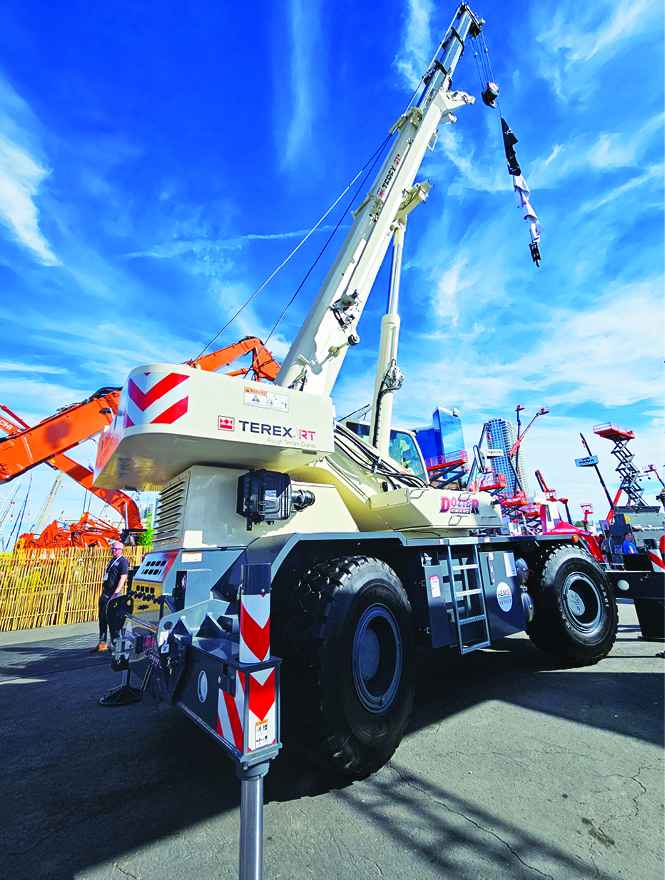
The TRT 55US features a compact design for easier transport, a redesigned operator environment and an additional jib configuration. It offers a maximum main boom tip height of 130 feet and a 26.25-foot jib for a maximum tip height of 157.5 feet. The crane includes three telescoping boom modes, including a proportional mode for simplified operation. Updates include improved load chart performance and enhanced stability through upgraded control and monitoring systems. Integrated systems include TEOS and T-Link, along with IdeaLift technology for asymmetric outrigger configurations in constrained conditions.
Terex also introduced the CTT 392-16 flat-top tower crane, with a 16-ton capacity and a maximum jib length of 75 meters, designed for large-scale commercial and infrastructure projects. Features include a frequency inverter for hoisting and trolley movements, automated safety diagnostics and a modular counter-jib system to simplify assembly and disassembly. The crane is compliant with OSHA and ANSI standards.
Sany
SANY’s SCA3300A crawler crane is a 330-ton machine with a maximum boom length of 302 feet and a Cummins-powered 400-horsepower engine. It features SANY’s load moment indicator system with a multi-display interface, 360-degree cameras and full boom walkways. The cab is the largest in its class, with variable electrochromic glass, air suspension seating and dual 12.8-inch touch screens. Boom configurations include fixed and luffing jibs, with the luffing jib extending to 377.3 feet.
The crane includes multiple hook blocks, winches with grooved drums and spring-applied, hydraulically released wet brakes. Independent main and auxiliary winches provide precise load handling, while the integrated hydraulic system supports pick-and-carry operations at 100% of rated load. Crawlers are mounted on a high-strength welded carbody frame with manual track tensioning, a maximum travel speed of 0.62 miles per hour and 30% gradeability.
Sany also featured the SCA1100TB telescopic crawler crane, lifting up to 110 tons with a 174-foot five-section boom. Standard features include pick-and-carry, wireless remote self-assembly, three-position side frames and a modular counterweight system. Safety features include over-hoist protection, 3rd wrap detection, mode switch for assembly or work and a high-definition camera system with night vision.
The SCD150 carry deck crane provides 15 tons with a 54-foot boom. Oblique-style outriggers, all-wheel steering, flexible boom nose and on-crane wireless remote enhance maneuverability and visibility.
MEC
MEC Aerial Work Platforms has entered the crane market with the unveiling of the CD-9T diesel carry deck crane. MEC noted that its lifting heritage, particularly in the boom lift market, made the move into carry deck cranes a natural extension.
The company says the CD-9T is designed around what it calls “-ability” for customers: visibility, comfortability, serviceability and availability. The deck is completely clear, with the engine mounted on the side, and six onboard cameras provide a bird’s-eye view. The cab is 25% larger by volume than competitive models and standard features include a suspension seat, air conditioning and heating and a cab door that can open either similar to a barn door or fully outward.
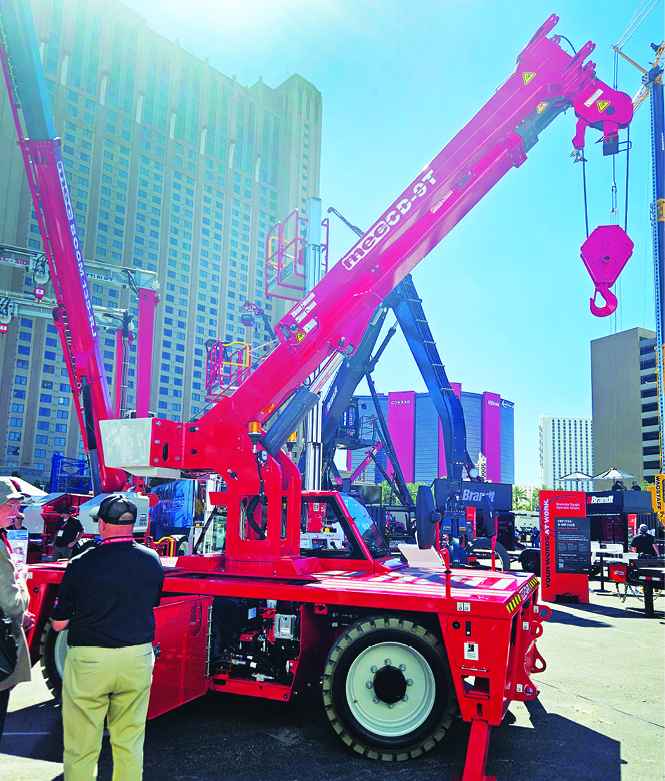
The counterweight swings sideways using three large bolts and a single pin, eliminating the need for additional equipment during service. MEC said the top panel will be hinged in production, allowing ground-level access to engine maintenance. The oil fill and yellow dipstick are also accessible from the ground, reducing the need for technicians to climb on the machine in poor weather conditions.
The CD-9T has a maximum lifting capacity of 18,000 pounds, a maximum sheave height of 46 feet, eight inches and a maximum horizontal reach of 40 feet with the standard 10-foot boom extension. The crane has a gross weight of 19,800 pounds and a stowed height of seven feet, 10 inches. Power comes from a 74-horsepower Deutz turbo diesel engine, paired with non-marking rough-terrain tires and a maximum drive speed of 15 miles per hour.
Platform Basket
Platform Basket displayed the 54 T WCH, a versatile, self-propelled, rubber-tracked lifter that can be used either as an elevating work platform or equipped with a winch to work as a crane. This telescoping lifter can work at heights to 177.17 feet and offers a maximum lifting capacity of 2,204 pounds, according to the company. The compact winch is fully hydraulic, controlled remotely and equipped with enough rope to handle material on roofs and other elevated spaces. The maxiumum lifting speed is 65.6 feet per minute. The unit complies with the UNI EN 13000 and ISO4301-1/2 standards for cranes, mobile cranes and lifting appliances.
The 54 T WCH can be converted quickly and easily from a work platform to a crane by simply replacing the basket and basket rotation parts with the winch. It features a quick removal of the support and basket rotation parts. With this configuration, this machine offers versatility and allows for different types of work with a single machine.
Goldhofer
Goldhofer introduced the PST/SL-E split with widening system, bringing its world premiere from bauma 2025 to the North American market. The trailer supports an axle load of 99,000 pounds and a variable width from 10 to 17 feet, extendable to 22 feet, providing enhanced flexibility for transporting oversized loads. The system includes the new E-PowerPack, rated at 250 kilowatts, and a revised operating concept that combines a modern remote control, ultra-bright LED display and integrated inclinometer for improved precision and operator control.
The PST/SL-E is designed for rapid deployment in specialized applications, supporting short- and long-load configurations with maximum accuracy. Its combination of high output, adaptable width and advanced controls allows operators to manage heavy or high-profile cargo with efficiency and safety.
Goldhofer rounded out its show lineup with models such as the THP/DC heavy-duty module and the STZ-H 6 semi low loader.
Bigfoot Construction
Bigfoot Construction Equipment had several products on display. Among the highlights was a new red outrigger pad, not currently available on the market, developed for cranes rated at 50 tons or less, operating on grade A soil or better conditions.
The company also displayed adjustable leveling pads designed to help stability on uneven terrain. The pads rotate to balance the load and are available in multiple sizes.
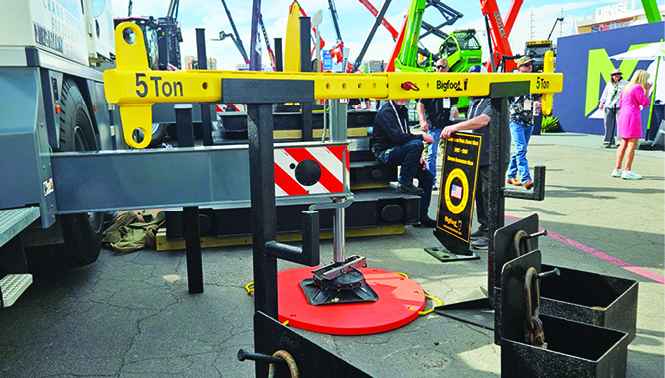
Additional products on display included chain caddies offered in three sizes and a five-ton adjustable spreader bar. Bigfoot said its spreader bars are designed for overhead lifting applications and can be used to distribute loads safely and evenly. The bars are part of a larger line of lifting beams and spreaders ranging from 1/4 ton to 20 tons in capacity and from three feet to 40 feet in length, with the five-ton adjustable model among the most commonly used.
Bigfoot also introduced a rope and cordage line that includes rope, twine and cable-pulling and measuring solutions used for installation, layout and material-handling tasks.
DICA
DICA had its new lineup of engineered ground protection mats on display at this year’s event, including the Ranger HD, Defender MD and Titan systems. Designed to provide stable, uniform surfaces for off-road equipment, the mats are intended for temporary access roads, work platforms and load distribution, offering an alternative to commonly used materials such as plywood.
Ranger HD is the lightest option, suited for equipment such as skid steers and telehandlers. It is designed for applications including tree care and concrete pumping, with performance based on ground conditions and equipment weight.
Defender MD fills the gap between lightweight and heavy-duty mats, offering increased stiffness without additional weight. The mats are designed to overlap and interlock, creating a more uniform surface that reduces gaps and improves stability for equipment operating in softer conditions.
Titan is intended for larger equipment and more demanding environments. Its solid core design allows it to flex with the terrain while maintaining load distribution, supporting use in softer ground conditions.
All three mat systems are manufactured from virgin resin and feature a gray, UV-resistant color to reduce heat absorption, limit thermal expansion and improve durability. The material also resists rot, helping maintain consistent performance over time.
Michelin
Michelin highlighted its next‑generation crane tire technology with the expanded X‑CRANE 2 lineup, designed for mobile and all‑terrain cranes used both on‑ and off‑road. Building on more than a decade of development and industry collaboration, the new X‑CRANE 2 combines a construction‑grade casing with a truck‑inspired tread pattern to offer higher load capacity and improved operational performance compared with previous Michelin crane tires.
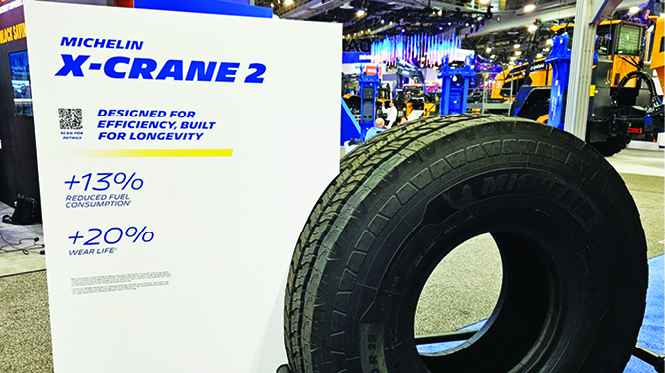
The tires feature updated load and speed indexes, which allows each tire to carry approximately 1,764 pounds more at highway speeds compared to earlier designs, translating to roughly 0.66 tons of additional load capacity per axle. The tire is also about 5% lighter than its predecessor, the X‑CRANE +, helping reduce rolling resistance. The company reports that this lower resistance leads to more than a 13% reduction in fuel consumption in typical
operating distances.
According to the company, the X‑CRANE 2 has been endorsed on a broad range of machines in both European and American markets, including models from Liebherr, Grove, Tadano and Link‑Belt.
Nelson Manufacturing
Nelson Manufacturing Company showcased several updates at the event this year, with particular emphasis on the all-new West Coast Crane boom dolly. Designed for the California market, the dolly features optimized axle spacing and a trailing rear axle, reducing the turning radius for improved maneuverability. The updated model includes an airbag boom tower support system, allowing controlled movement of the tower to streamline boom connect and disconnect operations safely and efficiently.
Alongside the crane boom dolly, Nelson displayed the updated BLXLT line of boom launch trailers. The showcased 2+2 configuration supports heavier axle loads for specific regional requirements and retains standard features such as a self-contained hydraulic power unit, hydraulic leveling legs, modular boom supports, boom side shift and wireless remote controls. Counterbalance lift cylinders, check valves and manual backup controls remain standard.
The company also displayed a 50-ton hydraulic bi-fold ramp trailer with five axles optimized for use in Michigan, including a hydraulic winch on the gooseneck, air lift axles and expanded metal decking in customer-specified locations. At the show, Nelson included a tri-axle CBC-30S crane boom dolly with a floating boom tower, outrigger pad holders and customized storage boxes.
OverWatch
The OverWatch Precision Targeting Optics – Apex system is a crane alignment tool designed to improve control during lifts by providing a real-time reference at the boom tip. The system helps operators and riggers detect and correct load drift when it starts, rather than after movement has occurred, by using a proprietary reticle that represents the boom tip’s center of gravity and an auxiliary line for rapid alignment.
The system integrates a 30x high-definition optical camera with stabilized viewing of the lift area, under-hook personnel and boom tip, alongside video and audio recording for operational review, training and documentation.
OverWatch features a fully wireless architecture, drawing less than 20 watts from existing boom-light circuits, and can be deployed to different cranes in under 10 minutes using a patented boom-clamp mounting system. It is compatible with multiple crane styles, including lattice and jib configurations, and supports short- and long-boom setups, with extended-reach options available.
PALFINGER
In addition to the display of the PK 580 and PK 1050 TEC knuckle-boom cranes, PALFINGER also had the new VR2 training simulator ready for play tests by booth visitors. The training simulator combines risk-free repetition with authentic operating scenarios and realistic crane physics to create a safe, risk-free environment for training operators.
The simulator offers a portable setup and an authentic PALCOM P7 remote for operation. The remote, with original PALFINGER-style controls, provides familiarity through levers and joysticks used in real situations. The headset is wireless, allowing users freedom of movement without being tethered to a console or computer, and features the latest in virtual reality technology with clear visuals and realistic depth perception. The program has various scenarios, attachments and loads through structured lectures and task-based exercises. The simulator also provides step-by-step instructions with clear, on-screen text.
A1A Software
A1A Software showcased updates and new tools designed to support crane, rigging and heavy equipment operations. Central to the display was the fully integrated A1A product suite, which combines applications for lift planning, rigging design and site visualization.
The suite features 3D Lift Plan, the company’s established software for simulating complex lifts and coordinating equipment placement across mobile, tablet and desktop devices. Supporting tools demonstrated at the booth included SketchPad, for capturing jobsite layouts and crane positioning in the field, and Jobsite Designer, which allows detailed visualization using satellite imagery, CAD imports and custom shapes. Rigging Designer simplifies the creation of complex rigging configurations through a drag-and-drop interface.
A1A also debuted 3D Lift Vision, a virtual crane simulator that converts lift plans into immersive simulations. Attendees could experience the tool firsthand using the VR lift simulation chair, providing an interactive way to evaluate lifts and support training.
The company offered a first look at iFleetTrax, a next-generation operational platform evolving from iCraneTrax. iFleetTrax is designed to manage customer relationships, quoting, invoicing, dispatch scheduling, job calendar and fleet performance reporting, with telematics support for enhanced equipment visibility.
CM Labs
CM Labs has expanded its Intellia Workforce training system, a workforce development solution that standardizes, manages and scales simulation-based operator training, to include new tracked excavator, CDL and crane simulations. The system adds new capabilities, including Intellia Trainee, a web-based curriculum for self-directed learning without simulator time, a voice-activated AI assistant and a leaderboard feature to encourage collaboration and competition.
The training system now has crawler crane, dual lift, luffing tower crane, flat top tower crane and rough terrain crane simulations.
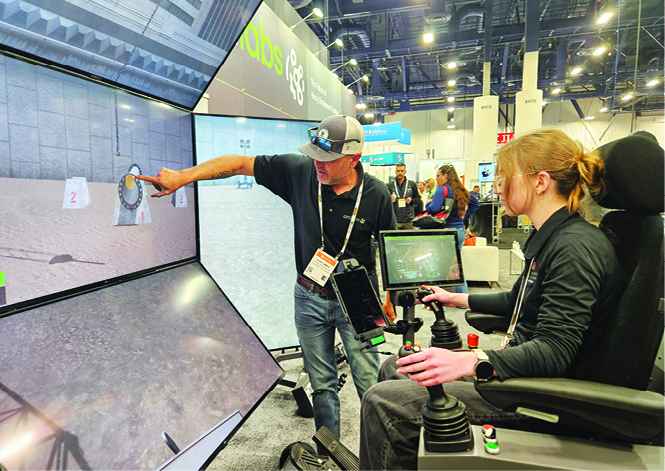
The expanded Intellia Workforce system integrates hardware, curriculum and management tools into a single platform and enables one instructor to oversee multiple trainees at once. Simulations can include team-based exercises, such as coordinating lifts with multiple machines and crews, while providing real-time monitoring of operator performance via tablet and drone views.
The curriculum has also grown to include web-based modules and more than 1,000 expert videos. Plug-and-play controls make it easier to switch between different equipment types on the same hardware, and mobile simulator units allow on-site training.
ITI
Industrial Training International (ITI) showcased its VR Crane Simulator, a virtual reality system designed to train operators on a wide range of cranes in a fully immersive, low-risk environment. The simulator supports heavy lift, crawler, rough terrain, lattice boom, tower, carry deck and boom truck cranes, allowing trainees to practice complex lifts without taking equipment out of service.
Recent updates to the system include a ten-ton overhead crane, expanded and more complex training scenarios and integration with a Magnetek XLTX bellybox transmitter developed with Columbus McKinnon Corporation. Multiple hardware options, including portable desktop setups and motion-based platforms, give organizations flexibility in how and where operators train. The simulator also features built-in reporting, customizable learning paths and more than 1,200 training and assessment scenarios, enabling instructors to standardize training and track progress across teams and locations.
The simulator was also named a finalist for the CONEXPO/CON-AGG Next Level Awards in the Technology category, recognizing its role in advancing construction training.
Kito Crosby
Kito Crosby has expanded its Easy-Loc collar pin system lineup, introducing updates intended to improve safety and speed during shackle connections. The Easy-Loc design requires pressure on both sides of the collar to release the pin, helping prevent accidental openings during lifting operations. According to the company, the system reduces pin removal time by about 90% compared with traditional bolt, nut and cotter pin assemblies.
Originally introduced for larger shackles, the Easy-Loc system is now being extended to smaller sizes, expanding availability from 75-ton shackles down to 25-ton models. Retrofit kits are also planned, allowing users to upgrade existing shackles with the collar pin system.
The updated design includes a lanyard hole that allows the pin to be secured with a safety cable, helping prevent dropped objects during work at height. The pin can also be drilled for additional securing methods where stricter drop-prevention requirements apply.
WIKA Mobile Control
WIKA highlighted updates to its crane and mobile machine technology, including the new UpFlex system designed to replace iFLEX2 and iFLEX5 units. The system allows operators to upgrade approximately 13,000 cranes without recalibration, eliminating the need for service technician visits. It works across Grove rough-terrain and truck cranes and connects directly to the crane’s CAN-BUS via onboard Ethernet for plug-and-play installation.
WIKA also showcased APEX wireless technology, including the SAI stand-alone indicator, which supports anti-two block switches and wind speed sensors and provides sensor status through a graphical display. The Apex TRS30-W3 gateway allows multiple wireless sensors to be connected with a long transmission range.
The company displayed sensors and components, including load cells, angle sensors, encoders and draw wires for boom angle, chassis tilt, slewing, outrigger position and load measurement. The gSENS LWG next-generation cable reels were also highlighted.
WIKA introduced the cSCALE compact mobile controller with Linux system, CoDeSys runtime, ARM Cortex-A7 processor, 140 megabytes RAM, 235 megabytes flash storage and SuperCAP UPS module. Electronic operating panels EOP 311 and 313 were also displayed.
Xtellio
Xtellio showcased its expanded industrial telematics platform, integrating ruggedized wireless Xenses sensors with wired Pro-Xentral devices to provide real-time operational data across fleets, machines and jobsites. Data from heavy equipment can be captured, transmitted to the cloud and directed through open APIs to give customers control of their information.
The system extends telematics beyond traditional heavy machinery, offering live diagnostics, GPS tracking and operational insights for auxiliary jobsite assets. Combined with Xense sensors, it can capture data including fuel levels and ambient conditions, supporting equipment management, compliance and efficiency. A notable addition is the Pro-Xentral – Heat IQ, a wired device for monitoring industrial heaters.
Xtellio emphasized scalability, allowing deployment across wired and wireless equipment. The modular design enables operators to monitor equipment and tools from a single interface. CEO Tom Valbak said the approach prioritizes customer data ownership, enabling custom dashboards, AI integration and more efficient operations.
The platform can unify telematics across mixed fleets, allowing contractors and rental companies to track usage, reduce downtime and gain insights without relying solely on engine-monitoring systems.
Maintainer
Maintainer used the show to highlight updates across its hydraulic crane lineup, including the 12630, 85630 and 75630 models, with a focus on added attachments, fall protection options and expanded jobsite versatility.
The 12630 hydraulic crane remains the largest in the group, with an 85,000 foot-pound crane rating and a lifting capacity of 12,000 pounds at six feet. At its maximum horizontal reach of 30 feet, the crane maintains a capacity of 2,893 pounds. The model features a hexagonal boom, a boom-mounted planetary winch and counterbalance valves on the extend and lift cylinders. A pistol-grip wireless remote and Advanced Crane Control 2.1 system provide operational feedback through a large LCD display.
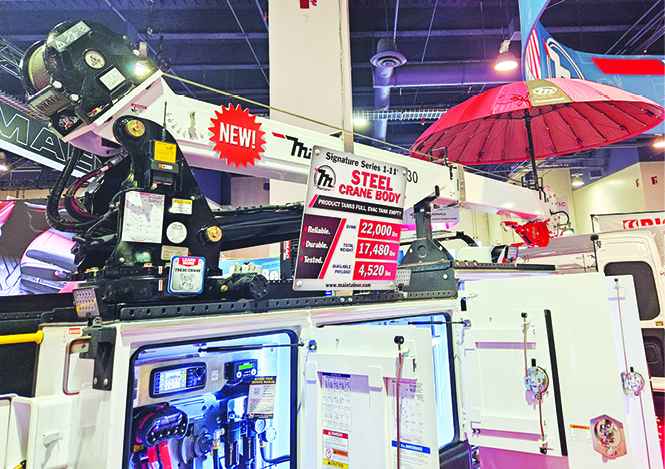
Several accessory options were also highlighted for the crane. A tire jib attachment expands lifting configurations, while a personnel tie-off option supports fall protection requirements for workers operating near the crane. One of the more unusual additions shown at the event was a customized umbrella holder designed to provide shade for operators.
Maintainer also displayed the 85630 and 75630 hydraulic cranes, which share similar boom design and control systems but offer lower crane ratings of 52,500 and 47,000 foot-pounds, respectively, along with different lifting capacities.
IMT
Iowa Mold Tooling Co., Inc. (IMT) brought out the new Series 5 telescopic crane lineup to the show. The family includes 16 models with boom lengths ranging from 18 to 32 feet and lifting capacities from 3,300 to 12,600 pounds. At the booth, the cranes were mounted on IMT Dominator mechanics trucks.
The Series 5 cranes feature IMT’s Penta Boom geometry, with the boom cylinder pivot repositioned to increase mechanical leverage in the 10- to 15-foot working range where many lifts occur. The lineup also uses high-tensile steel and a skeletonized structure to reduce weight while maintaining strength, helping improve truck payload capacity. All models feature fully hydraulic extensions and retain IMT’s established command control system.
Also on display was a Western Star 47X equipped with an Odyne plug-in hybrid system, paired with an IMT 50/345 articulating crane. The hybrid system allows the truck to operate in a stationary electric mode using a 35.4-kilowatt-hour battery, helping reduce fuel consumption and emissions during lifting operations. The battery can recharge while the truck is driving, allowing the crane to transition to electric power on the jobsite without sacrificing lifting performance.
Tiger Crane
Tiger Crane highlighted its largest model to date with the introduction of the 1593 hydraulic crane.
The Model 1593 offers a maximum lift capacity of 14,800 pounds and a 90,000 foot-pound crane rating. The hydraulic boom extends from 12.5 to 30.5 feet and provides a single-line reach of about 30 feet, eight inches, with a lifting height of 31 feet. The crane also offers 400 degrees of rotation and operates within a boom angle range of minus 20 to plus 75 degrees.
The crane uses a hexagonal boom design and a boom-mounted planetary winch with 120 feet of hoist cable. Operators control the crane through a wireless pistol-grip remote equipped with dual joysticks and a high-resolution LCD that shows load percentage and system diagnostics. The system also includes anti-two-block and overload protection indicators.
Tiger Crane also incorporated an Auto II speed control feature that reduces maximum operating speeds when a load is detected to help manage crane movement under load conditions while maintaining proportional control across the hydraulic functions.
Summit Truck Bodies
Summit Truck Bodies introduced its new 1229 hydraulic crane at the show, expanding the company’s crane platform into the 12,000-pound capacity class. The crane offers a 29-foot reach and weighs 205 pounds less than previous 12,000-pound models, a change the company said can increase payload capacity on service trucks.
The 1229 also debuted with Summit’s ASE Phase 5 control system, which adds an updated touch-screen interface, real-time diagnostics and predictive maintenance tracking. The system monitors crane and truck functions and can be operated from three control points: a rear compartment panel, an in-cab control panel and a wireless remote.
The crane features continuous rotation and a fully proportional control valve, allowing multiple functions to operate simultaneously. Several structural changes were also introduced, including a revised hexagonal boom profile and a redesigned rotate assembly. The crane uses a fully enclosed worm and gear rotate assembly paired with a double-row slewing bearing rated at 80,000 foot-pounds.
Additional updates include a relocated winch positioned behind the main boom pivot and a modular anti-two-block system designed with bolt-on components for replacement.