
All Terrain Crane Demand Grows With Data Centers and Infrastructure
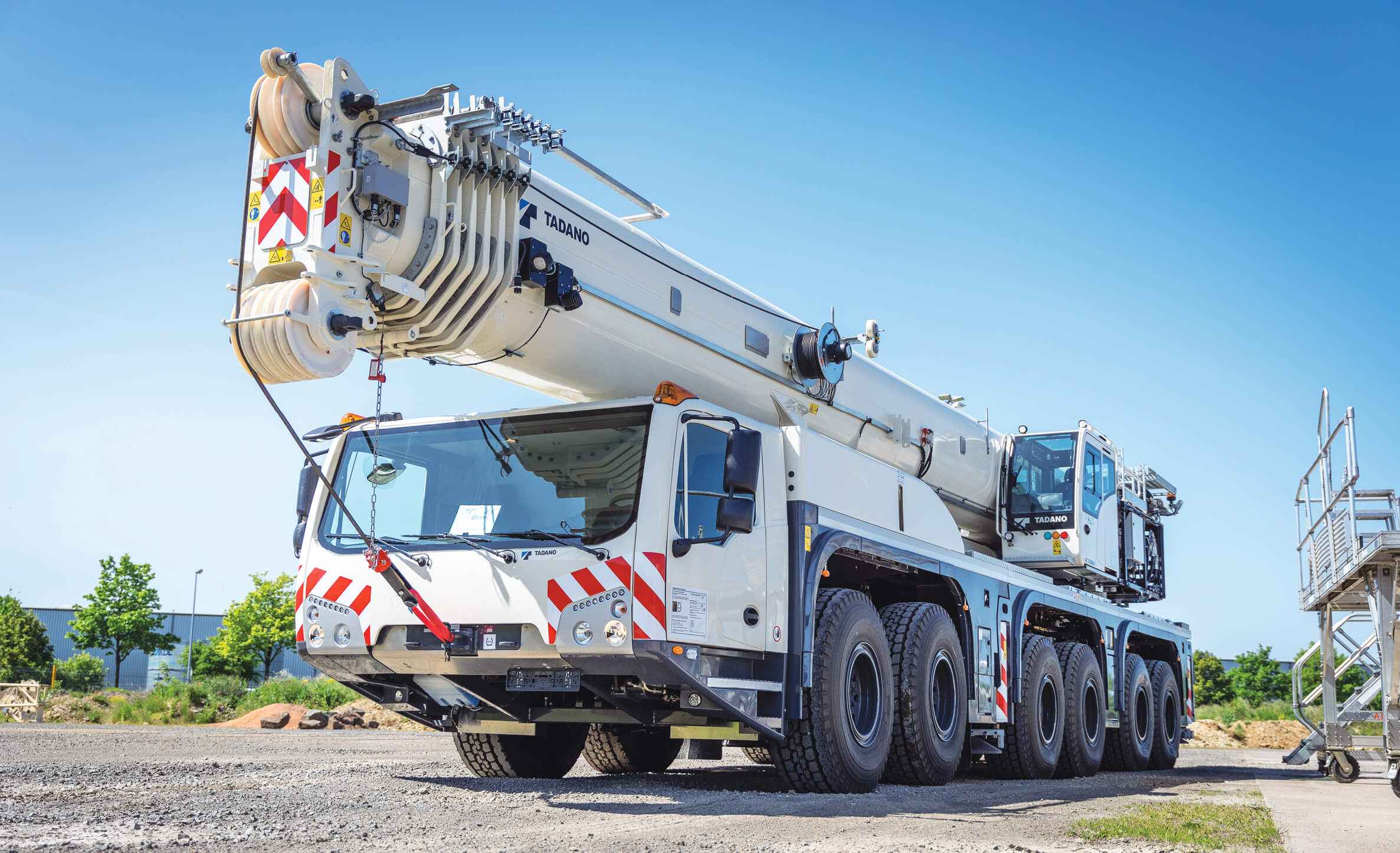
The all-terrain (AT) crane market is entering a new phase of growth defined by the rapid expansion of data centers, infrastructure investment, energy development and industrial construction growth.
Once valued primarily for their mobility, especially on urban jobsites and in challenging ground conditions, today’s AT cranes are also being specified for their technological sophistication and environmental performance. From hybrid-electric concepts to advanced control systems and operator-assist technologies, AT cranes are evolving to meet both operational and regulatory pressures.
Manufacturers report rising demand for AT cranes for their inherent versatility. Multiple sectors are fielding the machines, driven by the need for the ability to travel easily to jobsites, perform reliably both on-road and off-road, set up quickly and deliver high lifting capacity with a minimal footprint, especially when work is performed in confined urban or industrial environments.
Industry leaders, including Manitowoc, Link-Belt and Tadano point to the versatility of AT cranes as the main reason that the mobile cranes have become increasingly valuable on a broader range of projects than ever before.
Driving Growth
According to Josh Boyer, all-terrain application sales manager at Manitowoc, the most active applications for AT cranes today include commercial construction projects. “These cranes are especially active building new manufacturing plants, data centers, on oil, gas, petrochemical and other energy projects, and on infrastructure sites performing road, rail and bridge work,” he said.
At Link-Belt, Product Manager for All Terrain Cranes Andrew Soper also sees expansion across general construction and technology-related projects. “With the proliferation of data centers and the ever-increasing scope of general construction projects, AT cranes are used in a wider array of jobs than ever before,” he said. “They are now common for setting panels, loading and unloading components in laydown yards and for swinging steel.”
Tadano reported similar trends. “ATs work well when jobsites require ease of mobility and strong lifting capacities,” said Dan Melnyk, vice president of mobile crane sales - North America. “Demand has been strong across energy, civil, technology and new construction sectors because these cranes are ideally suited for tower crane and cell tower erection in urban construction, and general and heavy-lift applications.”
Flexibility
With customers seeking cranes that can adapt to many different site conditions, manufacturers are responding with more modular de-signs and configuration flexibility that enable a single machine to serve as a taxi crane one day and a heavy industrial lift machine the next.
Manitowoc’s Boyer explained that Grove AT cranes are designed for maximum adaptability. “There’s a range of fixed, telescopic and bi-fold extensions available, so customers can fit the right accessory to the boom to suit their particular needs,” he related. “Similarly, a variety of counterweight options allow owners to scale up or scale down depending on site requirements or local roading restrictions.”
Link-Belt emphasized transportability as a key advantage. “Maximizing uptime and machine availability are at the core of a successful crane business,” Andrew Soper said. “To meet these needs, we engineer ATs to meet all North American on-highway transportation requirements, and with modular counterweight configurations to minimize setup time and the number of required overflow loads.”
Dan Melnyk at Tadano also pointed to compact design and efficient setup as core strengths of AT cranes. “They work especially well because of their compact carriers and efficient set up and rigging processes,” he said. “Flexible transport and configuration options include quick connections for the main boom and outriggers, and liftable third axles and dolly preparation to comply with local road regulations.”
Embedded Intelligence
Tadano Surround View, Melnyk also reported, is used to support both driving and jobsite placement of AT cranes. “While turning the crane, blind spots are shown on the display in the carrier cabin,” he explained.” While placing the crane on the jobsite, the outrigger positions and tail swing of counterweight are overlayed on the display.
“The Tadano IC-1 Plus control system also provides operators with ease of operation, precise control of crane movements and advanced diagnostics,” Melnyk continued. “It enhances stability and precision with live determination of crane capacities, automatic counterweight detection and asymmetric outrigger settings.”
One of the defining technologies on Grove ATs from Manitowoc, according to Josh Boyer, is the manufacturer’s MEGAFORM boom design. “The U-shaped cross-section,” he pointed out, “provides for an enhanced strength-to-weight ratio, allowing users to reach further and lift more.
“Equally important in the Grove AT lineup,” Boyer added, “is the Megatrak suspension system, which eliminates traditional axles and allows all wheels to stay on the ground simultaneously for stability on uneven ground while reducing tire wear.”
At Link-Belt, related Andrew Soper, the Pulse 2.0 operating system, wireless rigging remote and Variable Confined Area Lifting Capacities (V-CALC) allow for infinite outrigger positions.
“In addition, our SmartFly technology allows fly assembly by only one operator working from ground level,” Soper continued. “Also featured on Link-Belt AT cranes is the SmartStack counterweight detection system and our Site Vision Package, which work together to enhance safety for operators on busy jobsites.”
Latest Developments
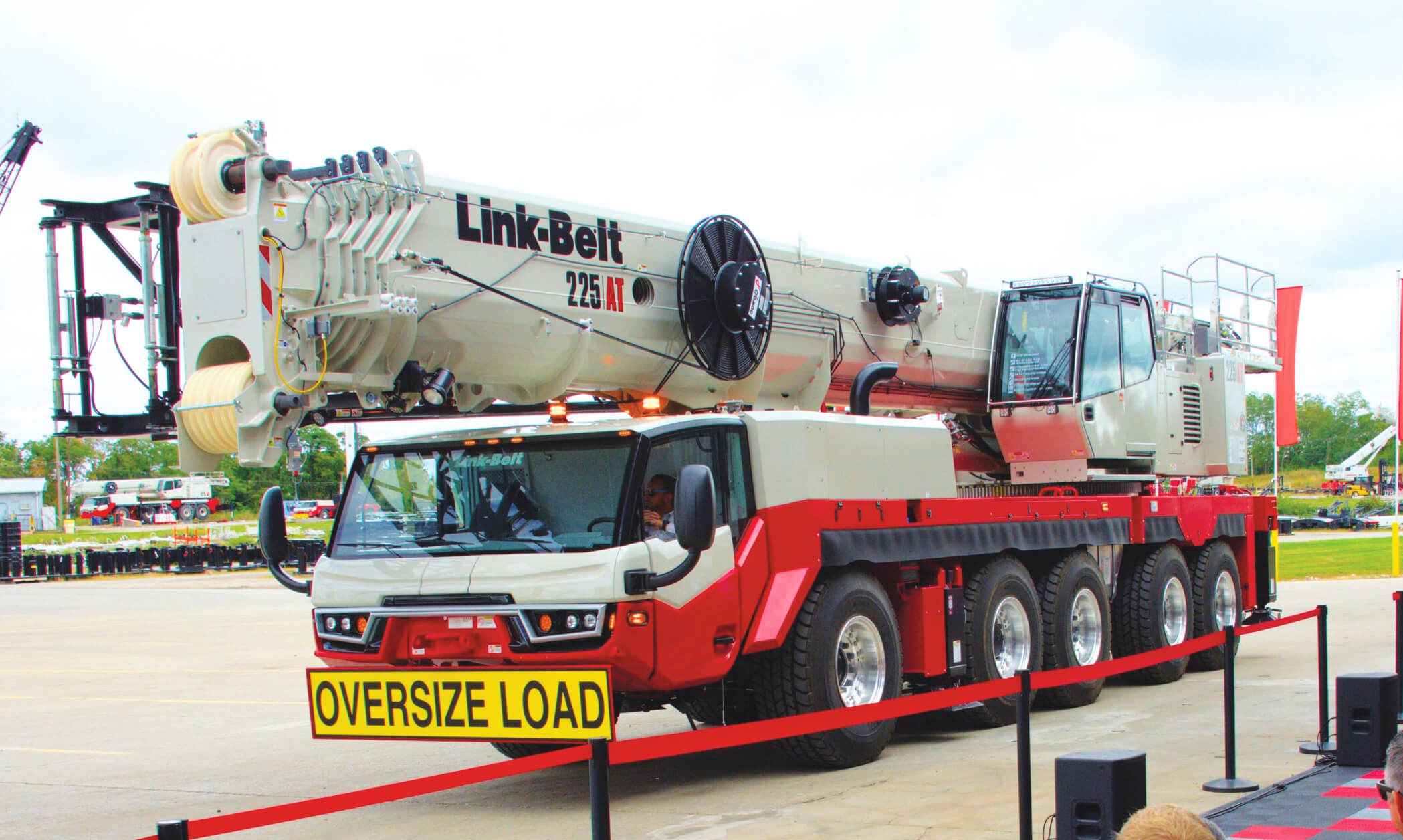
One of Link-Belt’s newest AT offerings is the 225-ton 225|AT, which features longer reach, larger capacities and more counterweight than its predecessor, the ATC-3210. The five-axle model has a 46–202-foot six-section latching boom, a 42–71-foot two-piece hydraulic offsetable SmartFly, an 8-foot heavy-lift jib, one or two 25-foot lattice fly extensions and a 334-foot maximum tip height.
The 225|AT crane is also offered with 118,000 pounds of maximum counterweight, a 29,392-pound maximum winch line pull and a maximum line speed of 450 feet per minute. The crane is designed with a single-engine platform featuring an EPA-compliant and HVO ready Cummins X-15 engine coupled with a ZF TraXon automated transmission.
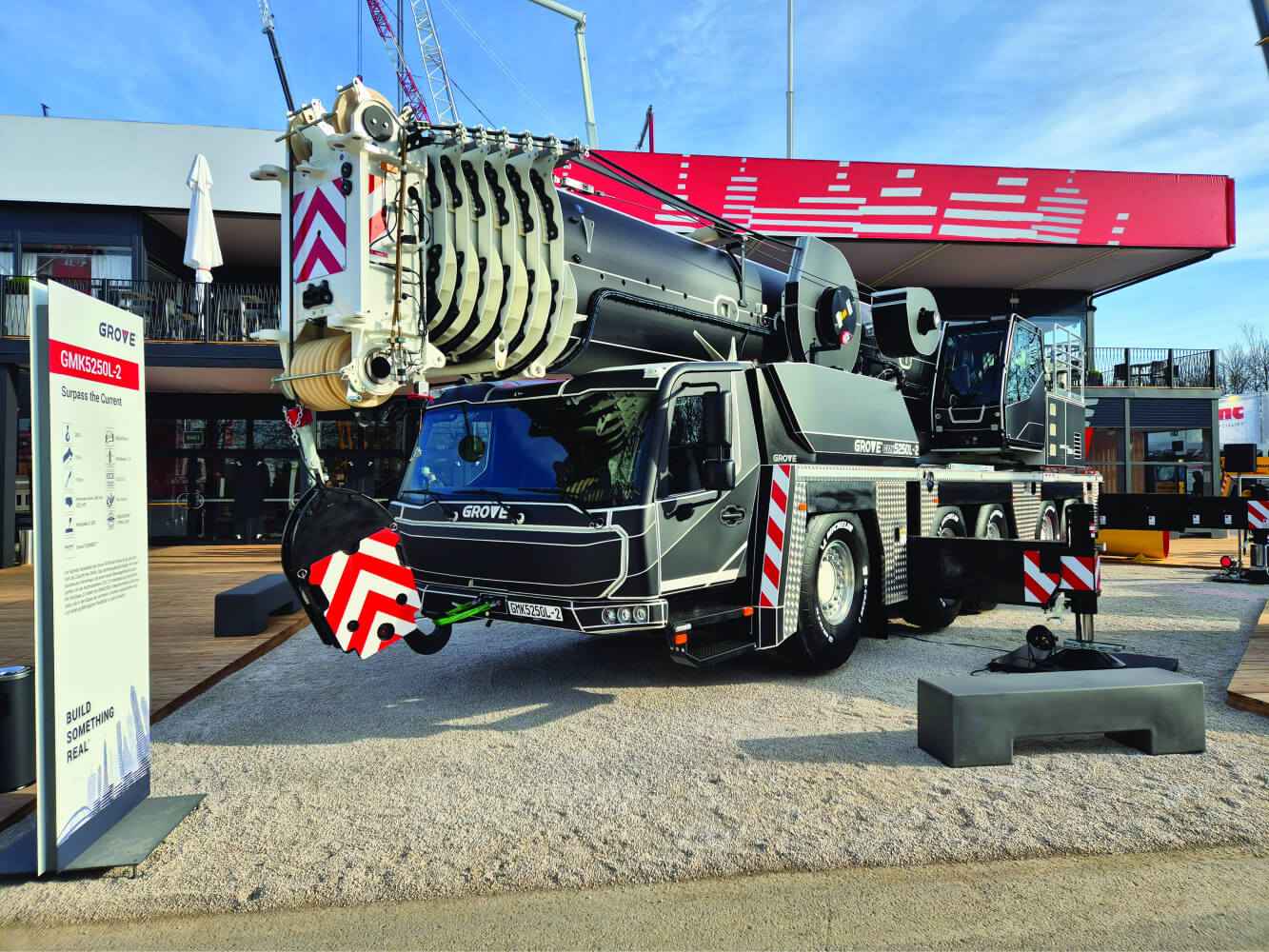
Offering a glimpse into its next generation of Grove all-terrain cranes is the prototype GMK5250L-2. Expected to be available for delivery in 2027, the five-axle model with a 250-ton capacity features new cabs on the superstructure and the carrier, the latest Manitowoc Crane Control System, CCS 2.0, and MAXbase 2.0, an improved version of the company’s variable outrigger positioning system.
Manitowoc has also launched its first plug-in hybrid AT cranes. The Grove GMK5150L-1e and GMK5150XLe feature 150 tons of capacity on a new, fully electrified superstructure powered by a battery pack with around 180 kWh of energy and with the ability to charge the battery from the grid. A 170-kW generator integrated into the carrier also allows charging while driving.
The battery pack on the Grove plug-in hybrids enables approximately five hours of lifting and when connected to the grid, crane operation can be extended to approximately 20 hours. Structurally, the main booms on the electric cranes are identical to the same diesel models, as are the load charts.
Tadano’s newest AT cranes, the AC 5.250-2 and the AC 5.250L-2, offer up to 30% higher lifting capacities than previous models. Other developments for the manufacturer’s AT product line include a new, bi-fold jib option for the AC 5.250 and the AC 5.250L-2 cranes. Also coming from the company is an AC 6.300-1 AT with a new rear Removable Outrigger Box to provide more transport flexibility and help with axle load requirements.
Cautious Optimism
Looking ahead, Tadano is cautiously optimistic that the AT market will expand. “Increased construction projects in North America, including chip plants, data centers, wind maintenance, bridges and the energy sector are driving demand,” said Melnyk. “At the same time, tariffs continue to push AT prices higher, however with the lack of supply of late model used cranes, new fleet expansion is necessary.”
Boyer at Manitowoc also sees environmental regulations as a major factor shaping AT orders. In particular, as cities and industrial sites place increasingly strict requirements on machinery, there will be a growing need to provide options to help achieve both commercial and environmental goals.
Link-Belt expects the North American AT market to “remain steady and strong in 2026,” said Soper. “Driven by large-scale construction and fleet replacement, AT cranes will thrive because their versatility, reliability and ease of transport all work in concert to drive continued growth.”
Across manufacturers and end users, the message is consistent: the all-terrain crane market is growing because these machines are the most flexible lifting tools available for modern construction projects.